
Revenue Leakage in Oilfield Services: The Seven Places 2-5% of Your Revenue Disappears
Your crew spent two hours on standby at the Johnson 4H waiting for the frac crew to clear location. Everyone on the pad saw it. Nobody wrote it down. The ticket shows the job, the invoice matches the ticket, and the operator pays it on time.
Those two hours are gone. No one disputed them. They were never billed.
That's revenue leakage: work your company did, at a cost it paid, that never turned into an invoice line. It doesn't show up as a write-off or a rejected invoice. It doesn't show up anywhere, which is why most companies underestimate it.
This guide covers how big the problem usually is, the seven places it hides, how to size each one, and a self-audit you can run this week.
How much leaks, and why the estimates differ
Enverus, which runs the OpenInvoice billing network, says most oilfield service companies lose 2 to 5% of revenue to work that gets done but never billed. On a $30 million business, that's $600,000 to $1.5 million a year.
You'll also see higher numbers, including 5 to 15% in our own guide, The Hidden Cost of the Field-to-Billing Gap. The two figures measure different things:
- 2 to 5% counts work that's never billed at all. Lost tickets, unrecorded standby, materials nobody wrote down.
- The wider range adds work that's billed for less than the contract allows, plus charges given up in disputes and charges forfeited because they were submitted too late. It's typical of companies still running on paper or a mix of paper and spreadsheets.
Either way, leakage costs more now than it did a year ago. In the Dallas Fed's third-quarter 2026 survey, oilfield services firms put their input cost index at 60.4 against 16.3 for prices received. One respondent summed it up: "We continue to see pricing pressure from operators, which will place further downward pressure on margins." When you can't raise your rates, billing everything you already do is the margin you can still control.
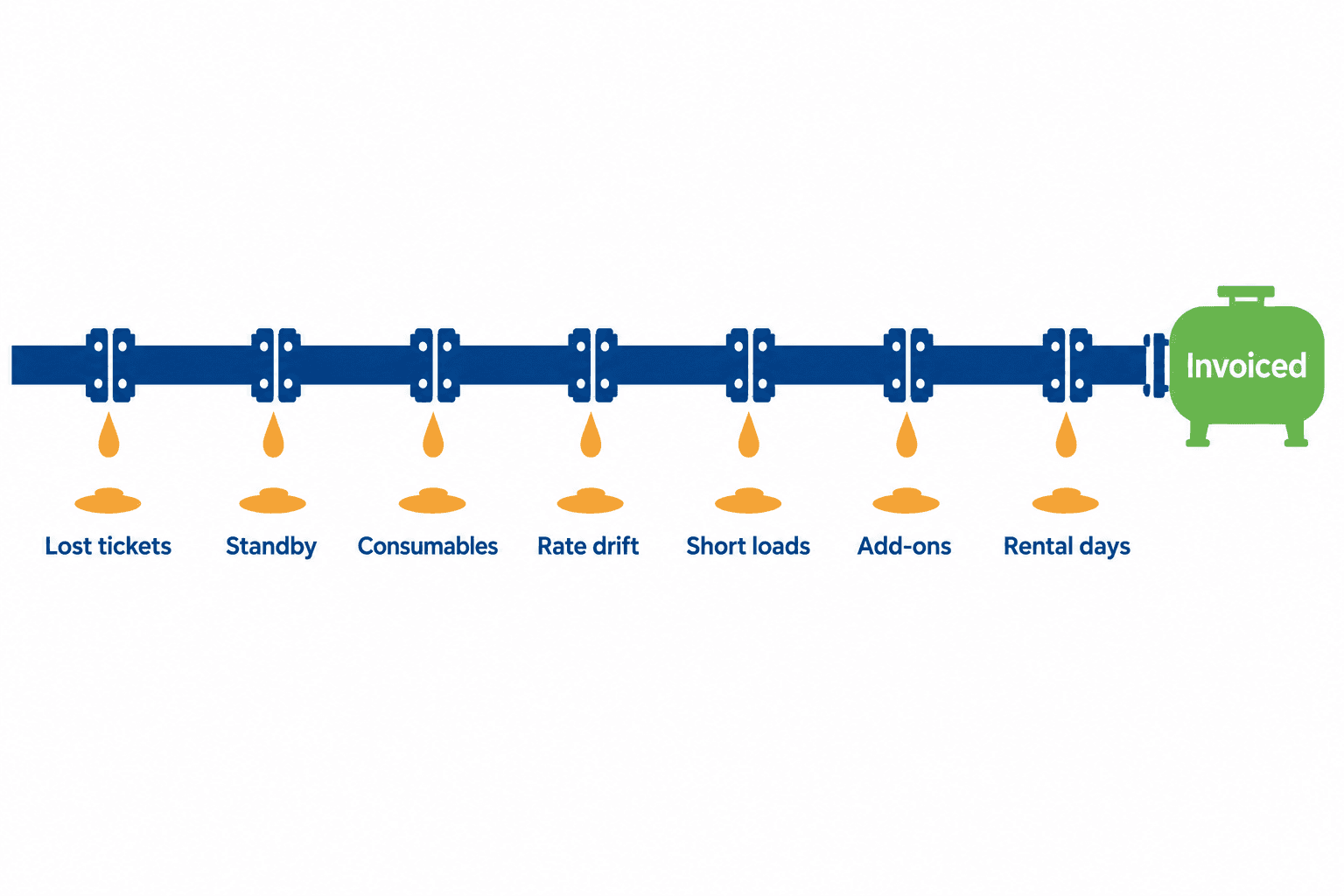
The seven places revenue leaks
1. Lost and late tickets
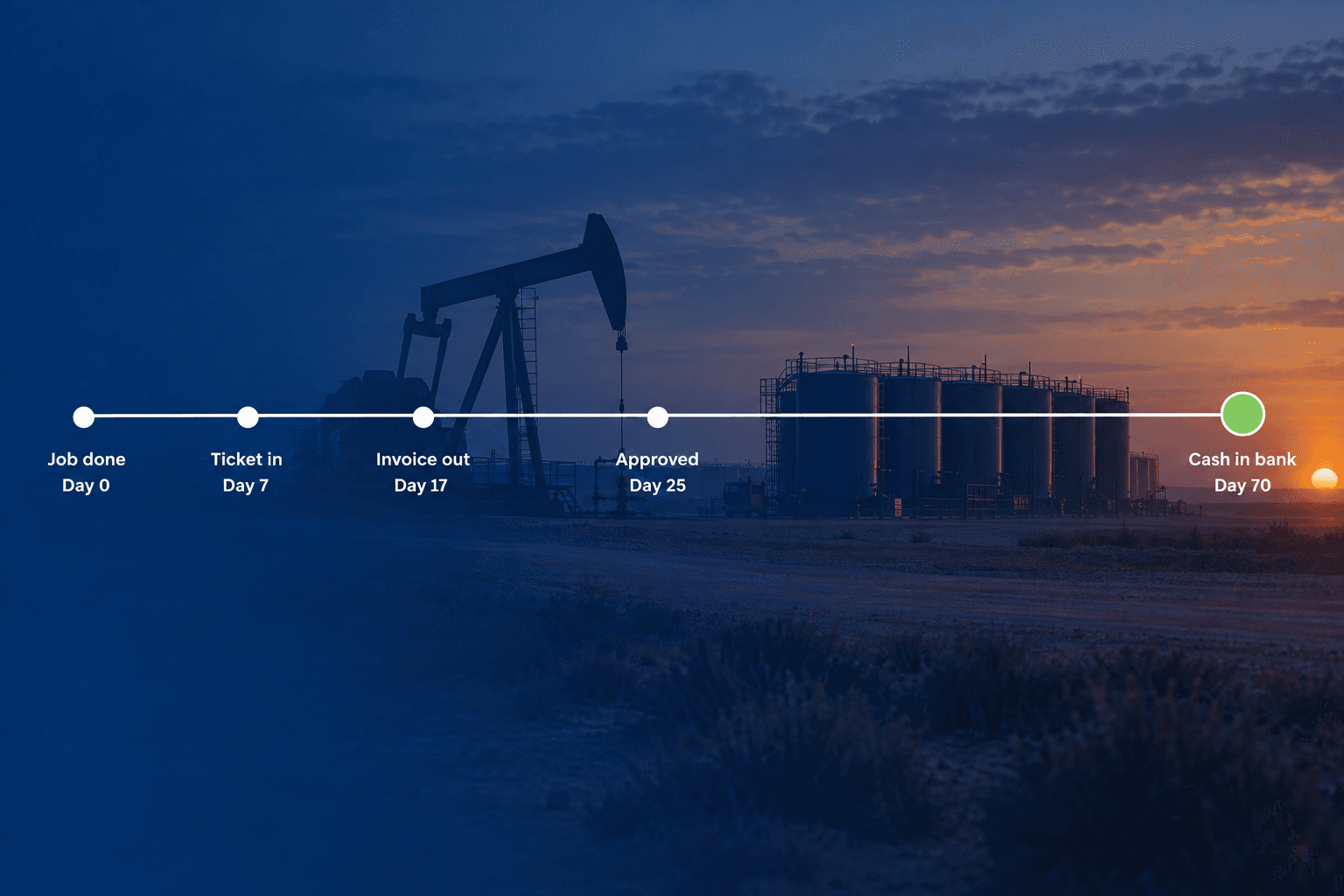
A ticket that never reaches the office is a job that's never billed. Paper tickets get left in trucks, soaked, misfiled or kept "until Friday". Even when they do arrive, they arrive late: Enverus puts the average time from service to ticket submission at more than seven days. Late tickets turn into lost revenue too, because many MSAs set a submission window. Equinor's US policy, for one, wants signed support within 60 days of the work.
How to size it: Take last month's dispatch log or job schedule and count jobs with no matching ticket. Multiply by your average ticket value.
2. Unbilled standby and wait time
Standby is the most common leak and the hardest to see. Crews wait on the rig, the frac crew, the company man, a plug, a permit. Most MSAs allow a standby rate, but the time only becomes billable if someone records the start, the stop and the reason, on location, while everyone still agrees on what happened.
How to size it: Compare clock-in and clock-out times from payroll or telematics against the hours on the ticket. Gaps of an hour or more on a single job usually mean standby that wasn't written down.
3. Missed consumables and materials
Fittings, filters, chemicals, gaskets, fuel, a few joints of pipe. Crews use them and forget to list them, especially when they're grabbed off the truck rather than pulled from the yard. Third-party purchases have the same problem: the hot shot, the rental pump, the parts run to town.
How to size it: Match inventory drawdowns and purchase card receipts for the month against materials billed on tickets. Whatever went out the door and not onto an invoice is your number.
4. Rate-sheet drift against the MSA
This one bills the work, just at the wrong price. A rate increase gets negotiated but never reaches the crew's copy of the price sheet. A ticket uses last year's rate. Hours are billed where the MSA allows a day rate, or the minimum charge is left off. Each error is small. Across a year of tickets, it isn't.
How to size it: Pull 50 invoice lines from last quarter and check each rate and unit against the customer's current MSA rate exhibit. Multiply the average shortfall per line by your annual line count.
5. Short loads and partial days
Hauling companies feel this most. A truck makes the full trip but carries less than capacity because the tank wasn't ready or the timing was off. In FieldEquip's illustrative example, revenue per haul drops 15% on a day when 5 of 14 trucks run short. The same pattern shows up as partial days in other service lines: a crew sent home at noon and billed for half a day, when the MSA allows a minimum charge.
How to size it: Compare barrels billed against truck capacity for the month, and check partial days against the minimum-charge clauses in each MSA.
6. Unapproved change orders and add-ons
The company man asks for one more thing while you're there. Run another line, swap a valve, stay for the next stage. The crew does it, because that's good service, but nobody writes it up as extra work with the customer's approval. Later, without a signature, it's your word against theirs, and AP won't pay a line nobody approved.
How to size it: Ask your crew leads to list the extra work they did last month. Then look for it on the tickets.
7. Rental days never closed out
Rental leaks run in both directions. Equipment goes out on Monday but the ticket doesn't reach the office until Thursday, so the rental clock starts three days late. At the other end, nobody records the call-off date, or the pickup sits for a week, and the days in between are lost or disputed. One Permian rental company we work with was losing two to three billable days on every rental this way.
How to size it: For every asset that went out last quarter, compare the delivery date from the trucking ticket against the first billed rental day.
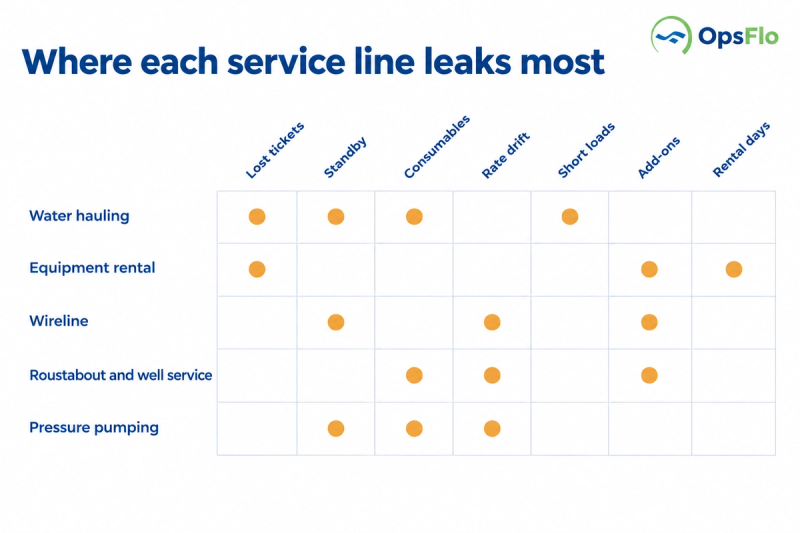
Where each service line leaks most
Every company has all seven leaks to some degree, but each service line has its favorites.
- Water hauling and fluid transfer: lost run tickets, short loads, wait time at the SWD, and disposal fees never passed through.
- Equipment rental: late rental starts, call-offs that never get recorded, and damage or lost-in-hole charges never billed.
- Wireline and completion services: standby waiting on the frac crew, misruns that were billable under the MSA, and per-run charges at the wrong rate.
- Roustabout and well service: materials bought on the way to location, overtime billed as straight time, and extra work the company man asked for.
- Pressure pumping and frac support: standby between stages, consumables, and rates that didn't catch up with a mid-year price change.
Run the self-audit this week
You don't need software to find your leaks. You need three records for the same jobs and an afternoon to compare them.
- Pick 30 to 60 recent jobs. Mix customers and service lines, and include a few long ones.
- Pull three records for each job: the signed field ticket, the payroll or timesheet hours for the crew, and the invoice that went out.
- Compare them line by line. Payroll hours against ticket hours. Ticket lines against invoice lines. Invoice rates against the MSA rate exhibit. Materials used against materials billed.
- Note every gap and its reason. Standby not recorded, material missing, wrong rate, ticket never invoiced.
- Put a dollar value on each gap, then divide by the revenue those jobs produced. That's your leakage rate for the sample.
Workforce software firm TimeTrex gives an example of what step 3 turns up: a crew paid for 11.5 hours on a job whose ticket billed 9, with no note explaining why. Every gap like that is either a payroll error or two and a half hours of unbilled work.
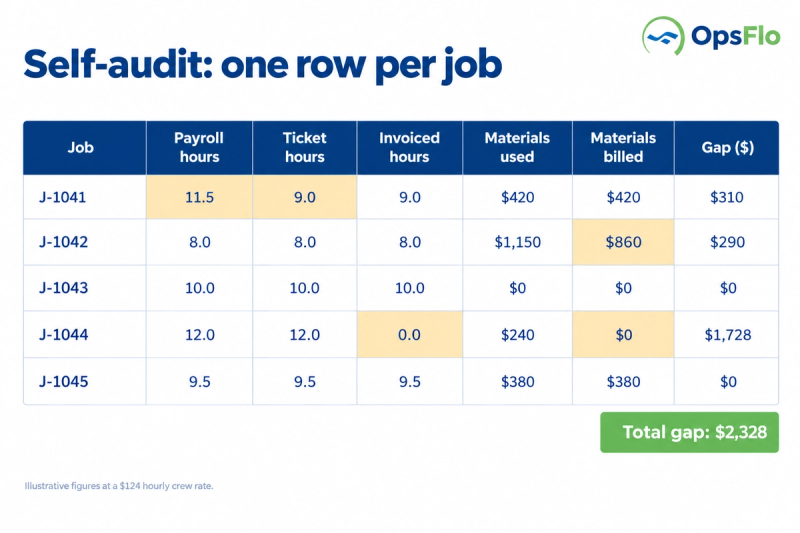
Most companies that run this audit find that two or three of the seven leaks account for most of the money. Those are the ones to fix first.
What under 1% looks like
A company with very little leakage doesn't have a better back office. It has fewer chances for work to go unrecorded. In practice that means:
- The ticket is created at the job. Not at the yard, and not on Friday.
- Required fields can't be skipped. Standby needs a start, a stop and a reason before the ticket can be submitted.
- Rates come from the price book. Crews enter quantities, never prices.
- Extra work gets its own line, signed on location.
- Rental clocks start and stop from timestamps, not from when the paperwork arrives.
- Every completed job is matched to an invoice, and anything unmatched shows up on a weekly exception report.
Two recoveries
The two case studies below show the same pattern from different sides of the business.
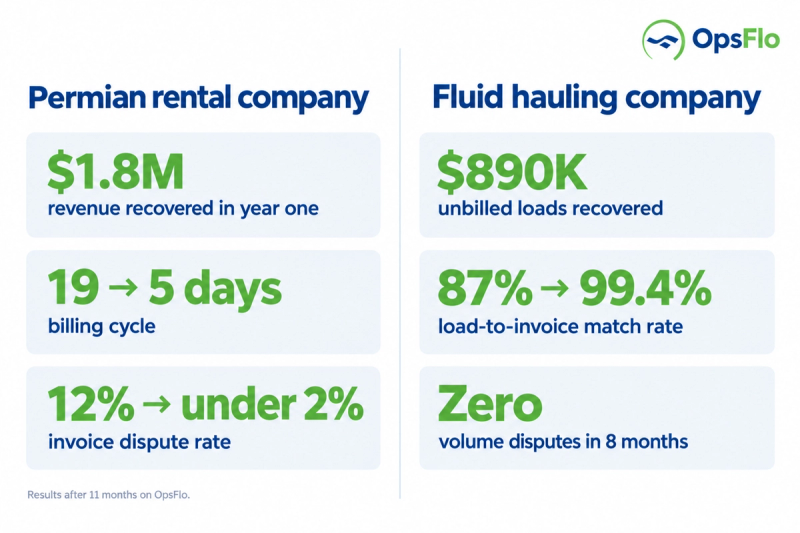
A Permian rental company (600+ rental assets). Equipment shipped on day one but wasn't logged until the paperwork arrived on day three or four, costing two to three billable days per rental. After 11 months on OpsFlo, it had recovered $1.8 million in revenue, mostly from accurate rental clocks and recaptured billable days. Its billing cycle fell from 19 days to 5, and its invoice dispute rate dropped from 12% to under 2%. Read the case study →
A fluid hauling company (38 vacuum trucks, about 14,200 loads a year). Paper bills of lading were lost or incomplete, and the operations manager estimated that 8 to 12% of loads had data gaps. After 11 months, GPS records had surfaced $890,000 in loads that were never billed. The load-to-invoice match rate rose from 87% to 99.4%, with no volume disputes in the last eight months. Read the case study →
Where OpsFlo fits
OpsFlo closes the leaks at the point where work happens. Crews create tickets on location in the OpsFlo app, which works offline. Required fields, photos and the customer's e-signature are captured before the crew leaves. Every line is checked against the customer's rate card and contract, so rate drift gets flagged before the invoice goes out. Rental assets carry their own start and stop records, and each ticket becomes an invoice that syncs to QuickBooks, NetSuite, Acumatica or another ERP.
Find out what you're leaving on the table
Book a 15-minute revenue diagnostic. We'll walk through your field-to-billing workflow and show you where the gaps are.
Or put a number on it yourself → /roi-calculator
Frequently asked questions
What is revenue leakage in oilfield services?
It's work your company performed but never billed, or billed for less than your contract allows. Common causes are lost tickets, unrecorded standby, materials left off the ticket, outdated rates, short loads, extra work nobody approved in writing, and rental days that were never closed out.
How much revenue do service companies lose to unbilled work?
Enverus puts it at 2 to 5% of revenue for most oilfield service companies. Companies still on paper or spreadsheets often lose more once underbilling and lost disputes are counted. On a $30 million business, 2 to 5% is $600,000 to $1.5 million a year.
How do you find unbilled field tickets?
Match your dispatch log or job schedule against the tickets you received, and the tickets against the invoices you sent. Any job without a ticket, and any ticket without an invoice, is a candidate. Sequential ticket numbers make gaps easy to spot.
What causes rate mismatches on oilfield invoices?
Usually an out-of-date price sheet in the field, the wrong unit of measure (hours instead of a day rate, for example), or a minimum charge that was left off. Rate increases that never reach the crews are the most common cause. Locking rates in a price book, so crews enter quantities only, prevents most of them.
How often should we audit for revenue leakage?
Run the full self-audit once to find your biggest leaks, then reconcile jobs, tickets and invoices weekly. Many companies also run a fuller reconciliation each quarter.
Related reading
- What Is a Field Ticket? The Complete Guide for Oilfield Service Companies
- Twelve Reasons Operators Reject Oilfield Invoices, and the Ticket-Level Fix for Each
- DSO Benchmarks for Oilfield Service Companies, 2026 Edition (with Calculator)
- How Excel Is Quietly Draining 2-3% of Your Oilfield Revenue Every Year
- Guide: The Hidden Cost of the Field-to-Billing Gap
Sources
- Enverus, Oilfield Services Suite: 2 to 5% of revenue lost to work done but never billed.
- Enverus, 7 Field Ticketing Pain Points in Upstream Oil & Gas (2025): average time from service to ticket submission.
- Federal Reserve Bank of Dallas, Dallas Fed Energy Survey, third quarter 2026: input cost and prices received indexes for oilfield services firms, and the respondent quote.
- FieldEquip, How Short Loads Are Quietly Draining Profit From Your Oilfield Logistics Operation (2026): short-load example.
- TimeTrex, Oilfield Well Service Margin Leak (May 2026): ticket, payroll and job cost reconciliation.
- Equinor, US Operations Invoicing Policy Standard (2022): 60-day window for signed support.
No comments yet
Be the first to share your thoughts.
Leave a Reply
Your email address will not be published. Required fields are marked *