



DSO Benchmarks for Oilfield Service Companies, 2026 Edition (with Calculator)
Your crew wrapped the job on March 3. The company man signed the ticket before the trucks rolled off location. Nobody disputes the work.
The cash lands in your account around May 12.
That gap has a name. Days sales outstanding, or DSO, counts how many days your revenue sits in receivables before it becomes cash. For an oilfield service company, it quietly decides whether growth gets funded from operations or from a credit line.
This guide covers what a good DSO looks like in 2026, how listed service companies actually perform by service line, a quick way to calculate your own, and the five fixes that take the most days off the clock.
What DSO measures and how to calculate it
DSO answers one question: how many days of revenue are you carrying as receivables right now?
DSO = (Accounts receivable ÷ Revenue billed in the period) × Days in the period
A worked example. Last quarter you billed $6.0 million. Today your receivables stand at $4.2 million. DSO = ($4.2M ÷ $6.0M) × 90 = 63 days. On average, every dollar you earn waits 63 days to reach the bank.
Two rules keep the number honest.
- Match the periods. Use a quarter's revenue with a quarter's days, or a year's revenue with 365.
- Count the work you haven't invoiced yet. Most accounting systems only see invoices. A signed ticket sitting in a truck or an inbox is revenue you've earned and not billed, and it belongs in the number.
The public companies show why the second rule matters. Liberty Energy, one of the largest US frac companies, reports $254 million of unbilled revenue as its own line on the balance sheet. Leave it out and Liberty's DSO for the second quarter of 2026 looks like 40 days. Put it back and it's 59. If your tickets still live on paper, find out how big your unbilled pile is before you trust your DSO.
What a good DSO looks like in oilfield services
Enverus, which runs the OpenInvoice billing network, publishes the clearest bands we've found. By its reckoning, under 35 days is strong, 30 to 45 is a sensible target when markets are steady, and a DSO that stays above 60 is a sign of cash strain. We label the stretch between 45 and 60 "room to improve", because that's what it is.
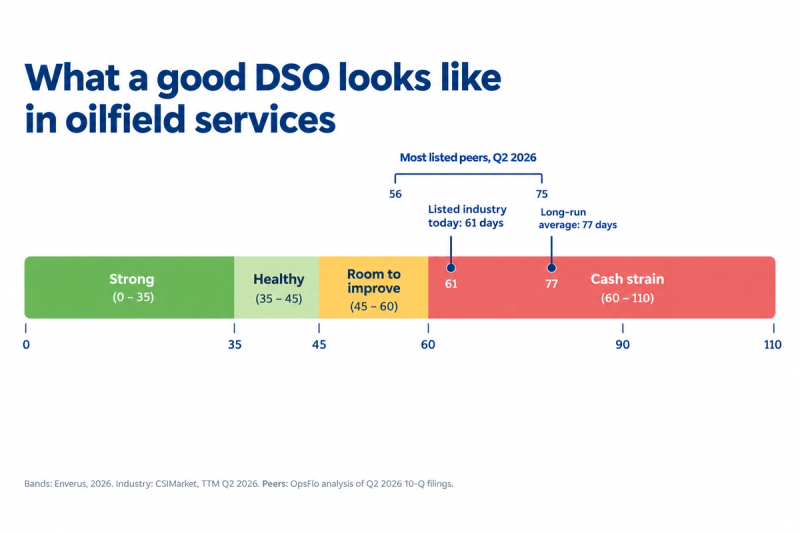
Here's the uncomfortable part: most of the industry lives above the strain line.
- Listed oil well services and equipment companies turned their receivables over 6.03 times in the twelve months to Q2 2026, according to CSIMarket. That works out to about 61 days. The group's long-run average is closer to 77.
- Factoring specialists see the same thing. PeerSense, which places oilfield receivables with factors, puts typical aging at 60 to 105 days from invoice, on Net 60 or Net 75 terms.
Four things stack up to make oilfield DSO long.
- Long terms. Net 45 to Net 75 is common, and some operators run longer.
- A clock that starts late. Payment terms start when the operator has a clean invoice in hand, not when the job ends. Every day before that is extra, and a rejection sends you back to the start. We covered the twelve most common rejection reasons in an earlier post.
- Slow tickets. Enverus puts the average time from service to ticket submission at more than seven days.
- Long approval chains. One ticket can need a field signature, a portal upload, cost coding and an AP review before anyone schedules a payment.
None of this is unusual, and that's the problem. When 60 days is normal, nobody asks how many of those days were self-inflicted.
DSO by service line: what the public filings show
Published DSO benchmarks for oilfield services are thin, and most stop at a single industry number. The best open data sits in the balance sheets of listed service companies, so we built the comparison ourselves. For each company, we took receivables at June 30, 2026 from its second-quarter 10-Q, added unbilled revenue where it's reported as a separate line, divided by second-quarter revenue and multiplied by 91 days.
- Frac and pressure pumping: 59 to 69 days (Liberty Energy 59, ProFrac 61, ProPetro 69)
- Wireline, coiled tubing and completion services: 66 days (KLX Energy Services)
- Water transfer, hauling and disposal: 74 days (Select Water Solutions)
- Artificial lift: 56 days (Flowco)
- Compression rental: 39 to 64 days (Natural Gas Serv
- Downhole tool rental: 104 days (Drilling Tools International)
- Diversified services and rental tools: 75 days (RPC)
- All listed oil well services and equipment companies: about 61 days (trailing twelve months)
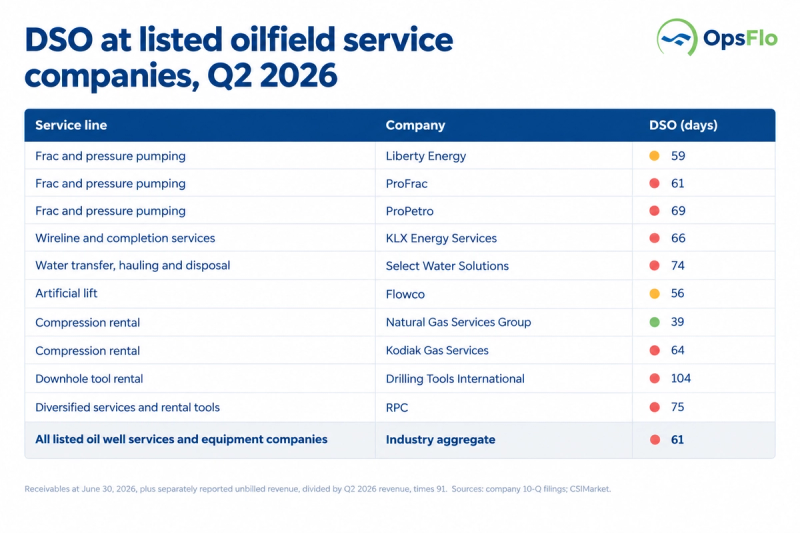
Three things stand out.
Almost everyone is above 45. Of the ten companies, only one, a compression rental business, comes in under 45 days.
Billing model matters more than the label. Rental alone runs from 39 to 104 days. How often you bill, how cleanly, and who you bill move the number more than what's on the trailer.
These are reference points, not targets. Public companies have dedicated collections teams and some of the largest operators as customers. A private company with tight tickets and a steady billing rhythm can beat them.
Calculate your DSO
Calculator embed — Dev note, not for publishing
Three inputs, all in dollars: accounts receivable today, signed tickets not yet invoiced (optional), and revenue billed in the last 90 days.
Outputs:
- DSO = (receivables + unbilled) ÷ revenue × 90
- The band it falls in:
- Strong: under 35
- Healthy: 35 to 45
- Room to improve: 45 to 60
- Cash strain: over 60
- Cash freed at a 35-day DSO = (DSO - 35) × revenue ÷ 90
If the component isn't ready, delete this block. The text below works on its own.
No calculator handy? Take your receivables today, including signed tickets not yet invoiced. Divide by what you billed over the last 90 days. Multiply by 90.
Then put a dollar figure on it. One day of DSO holds roughly one-thirtieth of a month's billing.
- $500,000 a month: about $17,000 per day of DSO, or $167,000 for every 10 days
- $1 million a month: about $33,000 per day, or $333,000 for every 10 days
- $2 million a month: about $67,000 per day, or $667,000 for every 10 days
- $5 million a month: about $167,000 per day, or $1.67 million for every 10 days
That's cash you've already earned. Pulling it 10 days forward needs no rate increase and no conversation with your bank.
Track two numbers next to DSO: average days from finished job to sent invoice, and the share of invoices sent back for correction. DSO tells you how long you wait. Those two tell you why.
Where the days go
Split DSO into its four legs and the picture changes. Here's an illustrative job on paper tickets and Net 45 terms.
- Job to ticket in the office: 7 days. The ticket rides in the truck, waits for the weekly drop-off, or sits in someone's inbox.
- Ticket to invoice: 10 days. Someone keys it into billing, looks up the rate, hunts down the PO and AFE, and waits for the next billing run.
- Invoice to approval: 8 days. The operator's portal checks coding and attachments, then routes the invoice for sign-off. A rejection restarts this leg.
- Approval to payment: 45 days. The terms in your contract.
Total: 70 days, right in line with the listed companies above.
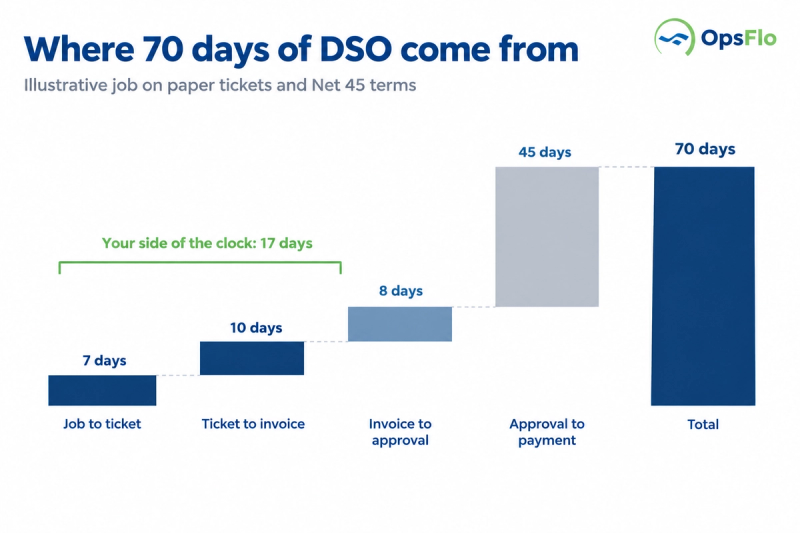
The first two legs, 17 days here, are entirely yours. They happen before your customer has even seen an invoice. The third is shared: the operator runs the approval, but most rejections trace back to a field on your ticket. Only the last leg is truly out of your hands, at least until the next MSA negotiation.
Five fixes, ranked by days saved
Each estimate shows its working, so you can rerun it with your own numbers.
1. Invoice as work is approved, not at month-end. Saves up to 11 days.
If you invoice once a month, the average job waits about 15 days just for the batch to close. Weekly invoicing cuts that wait to three or four days. For rentals, bill on the shortest cycle your MSA allows.
2. Close the ticket on location, the same shift. Saves about 7 days.
That's the seven-day average gap between service and ticket submission that Enverus reports. A ticket completed, checked and signed before the crew leaves reaches the office the same day.
3. Get invoices approved the first time. Saves 1.5 to 6 days across your book.
If 10% of your invoices bounce and each bounce costs two to four weeks, rejections alone add 1.5 to 3 days to your DSO. At 20%, it's 3 to 6. A 10% bounce rate isn't unusual: one casing contractor told Enverus it had around 10% of tickets sent back before it went digital. Most causes live on the ticket: a missing signature, the wrong AFE, a rate that doesn't match the price book.
4. Build the invoice from the ticket, with no re-keying. Saves a few days, and a lot of errors.
Every retype adds a queue and a chance for the typo that feeds fix 3. When the ticket already carries the price-book rate, the PO and the cost code, the invoice takes a click instead of an afternoon.
5. Work the aging weekly, by customer and by reason. Saves a few days, more with slow payers.
Sort open invoices by why they're open: awaiting approval, disputed, or approved and waiting for the payment run. Chase approvals first. An approved invoice pays on schedule. An unapproved one hasn't started the clock.
Fixes 1 through 4 all work on your side of the clock. Your customers' terms don't move, so your DSO drops by roughly the days you take out.
When factoring makes sense, and when it's a symptom
Factoring sells your receivables for cash now. Specialist oilfield factors typically advance 80% to 88% of an invoice and charge 1.5% to 3.5% per 30 days, an effective 18% to 42% a year, according to capital advisory firm PeerSense.
It makes sense when the gap is temporary and structural: a large new contract, a growth spurt, payroll through a ramp-up, or a strong customer on long terms.
It's a symptom when you're paying to finance your own paperwork. Say you bill $2 million a month and carry 10 days of avoidable delay: tickets waiting for the truck, invoices waiting for month-end. That's about $667,000 parked in receivables. Financing it at 2% a month costs roughly $160,000 a year.
There's a catch, too. Factors check the same things operators do. Unsigned tickets, disputes over whether a ticket is complete, and MSAs that prohibit assigning receivables can all block a deal. Fix the ticket and factoring gets cheaper, or stops being necessary.
Where OpsFlo fits
OpsFlo works on the part of DSO you control. Crews complete and sign tickets on location in the OpsFlo app. Every ticket is validated against the customer's rate card and contract, and missing fields are flagged before submission. The invoice is built from the ticket and synced to your accounting system, whether that's QuickBooks, NetSuite, Acumatica or another ERP, so nobody retypes anything.
In OpsFlo deployments, the stretch from finished job to sent invoice typically falls from 14 to 21 days to 2 to 5. That doesn't change what your customer's AP team does. It changes when their clock starts.
Get the CFO's playbook for reducing DSO
Seven practical actions, from measuring your ticket-to-invoice time to auditing unbilled work every quarter, in a short guide written for finance leaders.
See how OpsFlo shortens the billing cycle →
Put a number on your own business →
Frequently asked questions
What is a good DSO for an oilfield service company?
Under 35 days is strong, and 30 to 45 is a common target in steady markets, according to Enverus. Consistent readings above 60 signal cash strain. For context, most of the listed service companies we checked ran between 56 and 75 days in the second quarter of 2026.
How do you calculate DSO?
Divide accounts receivable by the revenue you billed in a period, then multiply by the number of days in that period. With $4.2 million in receivables and $6.0 million billed over 90 days, DSO is 63 days. Include signed tickets not yet invoiced for an honest figure.
Why is DSO so high in oil and gas?
Payment terms are long, often Net 45 to Net 75, and the clock starts only when the operator accepts your invoice. Tickets take a week or more to reach the office. Operator portals add multi-step approvals, where one rejection restarts the process.
How fast can digital field tickets reduce DSO?
They shorten your side of the clock. In OpsFlo deployments, the time from finished job to sent invoice typically falls from 14 to 21 days to 2 to 5 days. Customer terms stay the same, so DSO falls by roughly the days removed, plus whatever fewer rejections save.
Should an oilfield service company use factoring?
For a temporary, structural gap such as a new contract or fast growth, it can make sense. As a standing fix for late tickets or month-end batching, it's expensive at 1.5% to 3.5% per 30 days. Check your MSAs first, since some prohibit assigning receivables.
Related reading
No comments yet
Be the first to share your thoughts.
Leave a Reply
Your email address will not be published. Required fields are marked *

