
How Excel Is Quietly Draining 2-3% of Your Oilfield Revenue Every Year
A $50M operator loses $1-1.5M annually to spreadsheet chaos. Most of it is invisible. Here’s how the leakage happens, and how to stop it.
If you’re running an oilfield services business of any size, you’re running it partly on Excel. There’s no shame in it. Spreadsheets are powerful, flexible, and familiar. Every CFO learned to think in them. Every controller can pivot one in their sleep.
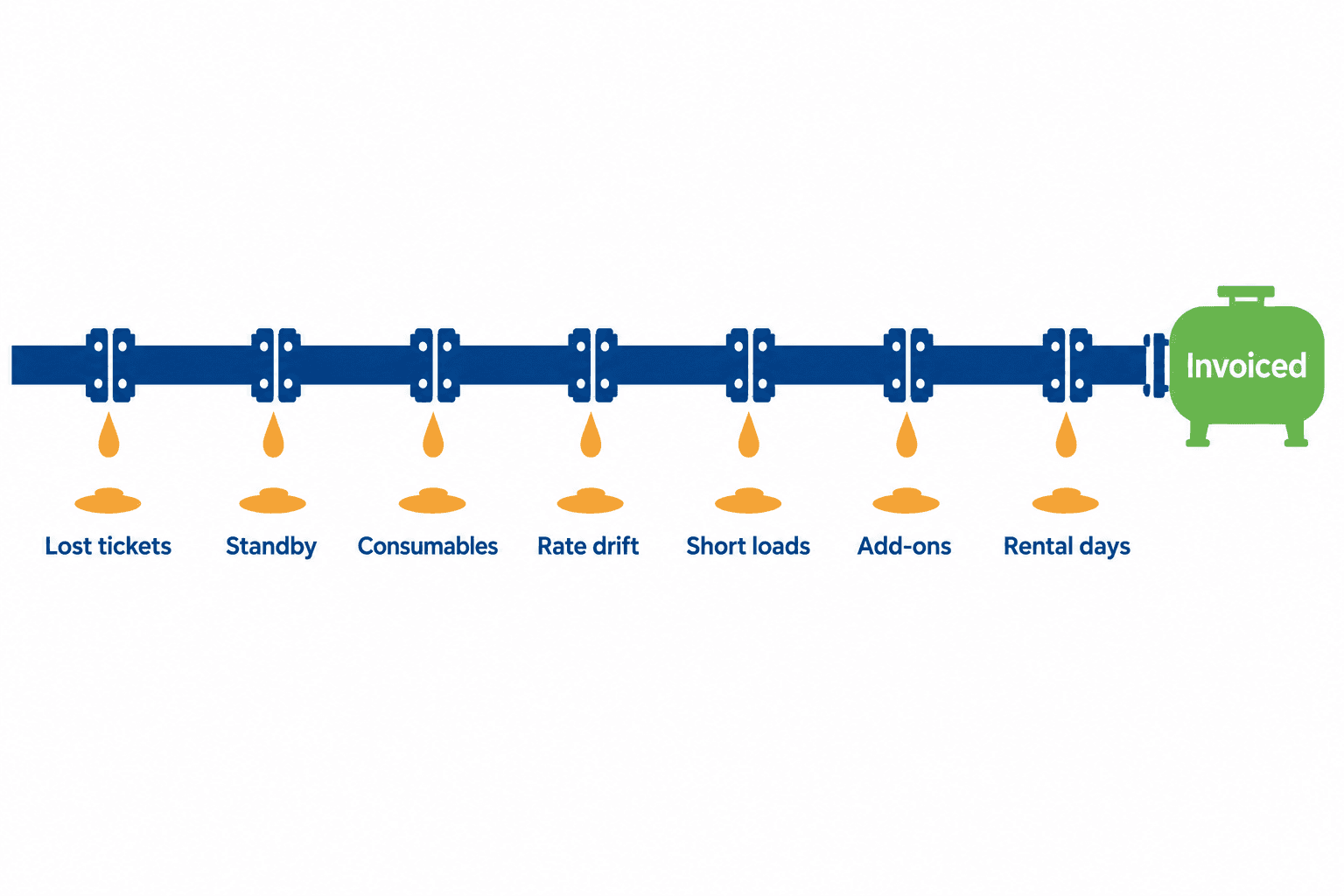
But spreadsheets have a quiet cost in oilfield services that most companies have never calculated. The number is bigger than most CFOs expect: 2-3% of annual revenue, lost to spreadsheet-driven inefficiencies.
For a $50M operator, that’s $1-1.5 million per year. For a $200M operator, $4-6 million. And the worst part is that most of it is invisible: it shows up in the financials as “operational variance” or “billing discrepancies” without ever being traced to its actual source.
Here’s how the leakage happens.
The Invisible $1M Spreadsheet Leak in Oilfield Services
A $50M operator loses $1–1.5M annually to spreadsheet chaos. Most of it is invisible. It shows up as “operational variance” or “billing discrepancies”—never as “Excel losses” on the P&L.
Here’s where the money actually goes, and how to stop the leak.
The five hidden costs of spreadsheet operations
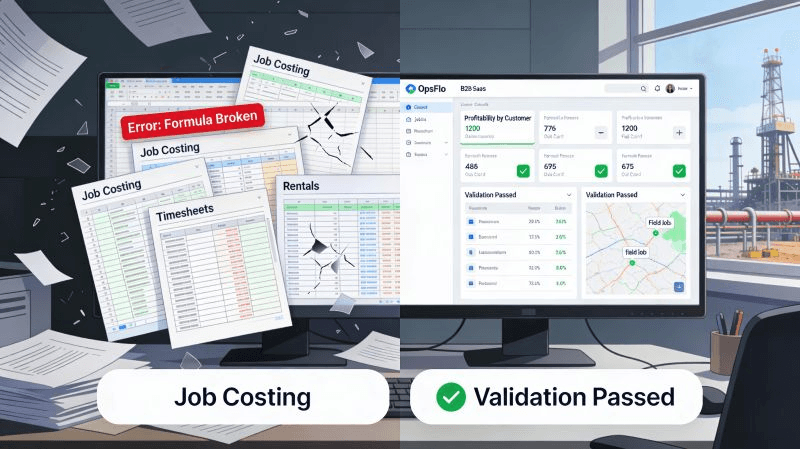
1. Formula errors that never get caught
Every finance leader has a war story:
- A cell pointing to the wrong column
- A pivot that double-counted
- A hidden row still feeding a total
In oilfield services, pricing models are especially fragile:
- Service codes
- Mobilization / demobilization
- Standby
- Consumables
- Hourly vs day rates
- Mileage and surcharges
Industry data suggests ~90% of spreadsheets used in financial reporting contain errors. In OFS, the complexity pushes that even higher. Most errors never get found—they flow straight into:
- Invoices
- Financials
- Management reporting
Impact: 0.3–0.5% of revenue.
---
2. Lost files and version control nightmares
Your pricing model exists in:
OpsFlo AI: The Intelligence Layer for Oilfield Field Operations
The next-generation intelligence layer purpose-built for oilfield field operations, and what it means for the way decisions get made.
For too long, “AI in oilfield” has been mostly hype.
Vendors have promised intelligence and delivered dashboards. They’ve promised predictions and delivered reports. They’ve promised assistance and delivered another tool to learn.
OpsFlo AI was built to change that pattern.
OpsFlo AI is the intelligence layer that sits across the entire OpsFlo platform: a system designed not to add another interface to your operations, but to fundamentally change how decisions get made in the field.
What OpsFlo AI does
OpsFlo AI is built around a simple principle: the frontline decision-maker should have the same quality of insight that’s typically reserved for the analyst three time zones away.
That means:
Instant answers to operational questions
No more digging through dashboards, building reports, or waiting on the analytics team. Ask the question, get the answer. In the language of your operation, with the specificity of your data.
Real-time insights from field data
Every job that runs through OpsFlo feeds the intelligence layer. Patterns get detected. Anomalies get surfaced. Trends get identified. Without anyone having to ask.
Decision support, not decision replacement
OpsFlo AI is built to make humans better at their jobs, not to replace them. It surfaces what matters, recommends what’s likely correct, and leaves the final call to the operator. Because oilfield operations require judgment that machines don’t have.
Where OpsFlo AI shows up
OpsFlo AI isn’t a separate product. It’s the intelligence woven through every part of the OpsFlo platform:
In Field Execution
- Suggests the right work order assignment based on crew certifications, equipment readiness, and historical performance.
- Flags potential issues before they become problems.
In Predictive Maintenance
- Identifies pre-failure signals across the asset fleet.
- Generates work orders with the right parts, the right technician, and the right intervention timing, automatically.
In Inspection and Compliance
- Auto-fills inspection data from photos and voice notes.
- Identifies compliance risks based on patterns.
- Flags inspections that need supervisor attention.
In Analytics and Reporting
- Powers the conversational analytics interface.
- Answers natural language questions about operations, finance, safety, and assets, in seconds.
In Dispatch
- Optimizes crew assignments across districts.
- Predicts customer arrivals.
- Recommends route adjustments in real time.
What makes this different
The market is flooded with “AI for oil and gas” platforms. Most of them are wrappers on generic models, trained on generic data, deployed in environments they don’t understand.
OpsFlo AI is different in three specific ways:
Trained on oilfield-specific data
Generic models don’t understand the difference between a frac stage and a wireline run. OpsFlo AI is trained on the operational patterns of oilfield services: the workflows, the failure modes, the customer dynamics, the regulatory context.
Works offline
The intelligence runs locally on the device when connectivity fails. Predictions, recommendations, and anomaly detection don’t stop when the truck rolls past the last cell tower.
Built for frontline decisions
Most AI products are built for headquarters. OpsFlo AI is built for the supervisor at the wellsite, the dispatcher at 4am, and the mechanic who needs to know what’s wrong with this pump right now. The interface matches how frontline operators actually work.
What this means for your operation
If your operations team is still waiting on reports, building dashboards, or guessing at next-best actions, OpsFlo AI represents a different operational paradigm.
The frontline doesn’t wait for analytics. The frontline is the analytics, informed in real time by the platform that’s already in their hand.
That’s the shift. And it’s available now.
Ready to see OpsFlo AI in action? Schedule a 30-minute walkthrough. We’ll show you how the intelligence layer transforms your specific operational workflows.
No comments yet
Be the first to share your thoughts.
Leave a Reply
Your email address will not be published. Required fields are marked *