

What Is a Field Ticket? The Complete Guide for Oilfield Service Companies
Every dollar an oilfield service company earns passes through a field ticket first.
The crew rigs up, does the work, and rigs down. Somebody writes down what happened — who was there, what ran, what got consumed, how long it took. Somebody from the customer's side signs it. That piece of paper, or that record on a phone, is the only proof the work happened. If it is wrong, late, or lost, the invoice behind it is wrong, late, or lost too.
Most people in this industry learn what a field ticket is by getting one rejected. This guide is the version nobody hands you on your first day: what a field ticket actually is, what belongs on it, who signs it, how it turns into money, and where the process breaks.
What a field ticket is
A field ticket is the record of billable work performed at a job site, created at or near the time the work happened, and signed by someone with authority to confirm it.
Three parts of that definition matter.
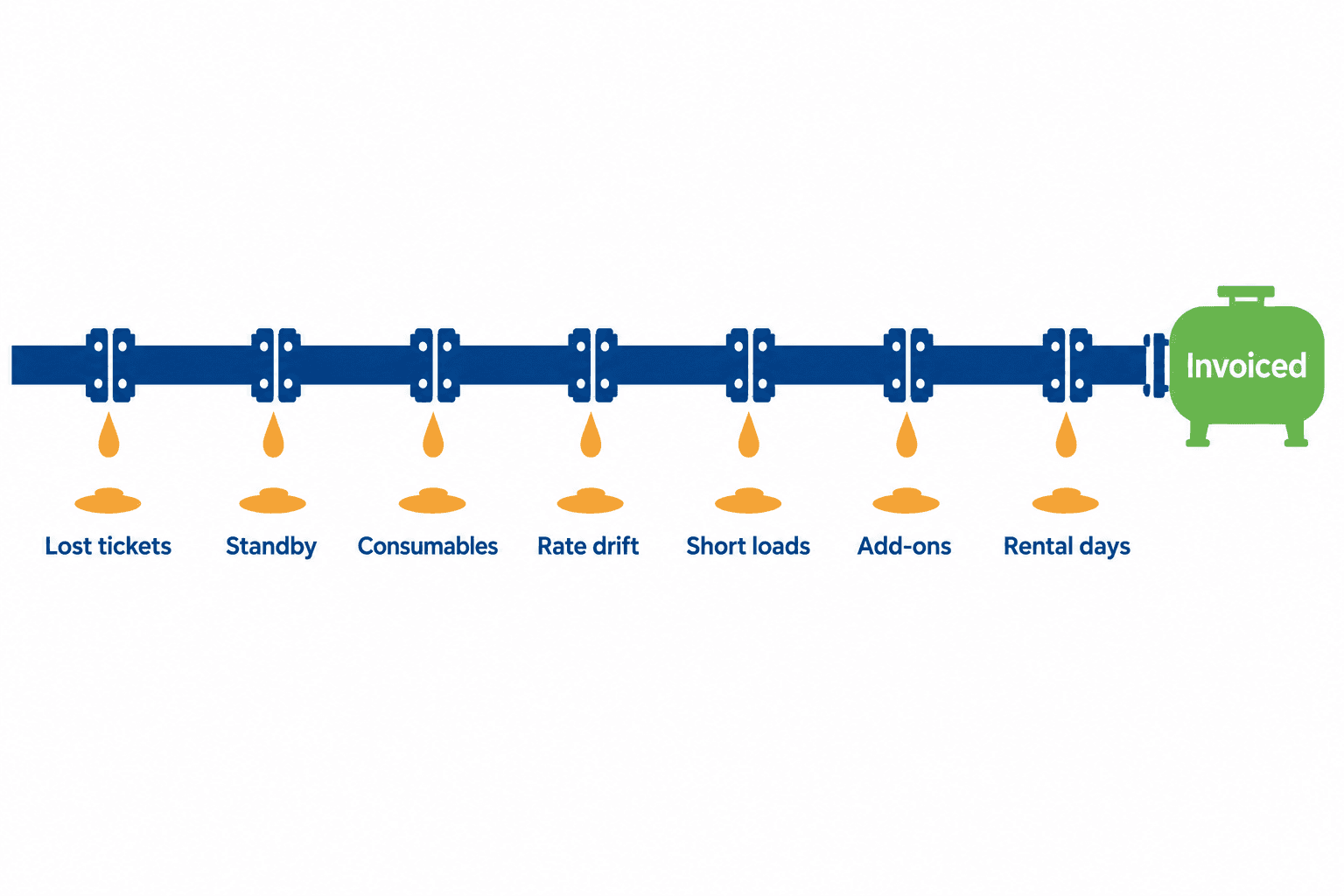
It records billable work. Not everything the crew did — everything the customer agreed to pay for. Those are different lists, and the gap between them is where a lot of revenue quietly disappears.
It is created at or near the time of the work. A ticket written three days later from memory is a guess. Hours get rounded, consumables get forgotten, standby time vanishes entirely.
It is signed. An unsigned ticket is a claim. A signed ticket is an agreement. Most operators will not process an invoice without one, no matter how accurate the underlying data is.
You will also hear field tickets called LEMs, run tickets, service tickets, work tickets, T&M tickets, or daily reports. The terminology shifts by region and service line. In western Canada, LEM — Labor, Equipment, Material — is the standard term. In the US oilfield, "field ticket" dominates. A water hauler says "run ticket." A wireline crew might say "run sheet." They all do the same job.
The practical point: use whatever your customer calls it, in whatever format they ask for. Aimsio makes this point well in their guide to LEMs — using the wrong template, even with completely correct information, is enough to delay an approval.
What goes on a field ticket
Every ticket has a header and a body. The header identifies the job. The body prices it.
The header: identifying the job
This is the part crews rush through, and it causes more rejections than the pricing does. A complete header carries:
- Customer name and the specific entity being billed. Large operators have many subsidiaries. The wrong one means the wrong accounts payable queue.
- Well name, lease name, or facility, plus the API number where relevant. "The pad off County Road 12" is not identification.
- Date of work. The date the work happened, not the date the ticket was written. These drift apart constantly on paper.
- AFE, PO, or cost center. This is the customer's internal budget code. Without it, most operators cannot route the ticket for approval at all. Get it at job setup, not at ticket time — the crew in the field has no way to invent it.
- Ticket number. Sequential and unique. This is what everyone will reference in the dispute you may have three months from now.
- Job or work order reference tying the ticket back to what was dispatched.
The body: LEM, plus the lines people forget
Labor. Names or employee IDs, classification (operator, supervisor, swamper, helper), hours split by regular, overtime, and double time, start and end times, and the bill rate per classification. Rates come from the agreed price book, not from memory.
Equipment. Unit number and description, hours of operation, whether it is owned or rented, and the bill rate for each unit. Where the operator is billed separately from the labor section, note that too.
Materials and consumables. Description, quantity, unit of measure, unit cost, and whether the item is passed through at cost or marked up. Crews need to know which materials are inside your scope and which are billable — that distinction is a training issue, not a form issue.
Then the lines that generate most of the arguments:
- Standby and wait time. Equipment sitting on location, ready but not working, at an agreed standby rate. This is the single most commonly missed line item in the entire industry.
- Mileage and mobilization. Getting there and getting home, where the contract allows it.
- Minimum charges. A four-hour minimum on a job that took ninety minutes is not padding. It is the contract.
- After-hours, holiday, and callout premiums.
- Third-party and subrental passthroughs.
The proof
Modern tickets carry evidence, not just numbers: photos of the work and the equipment on location, meter or gauge readings, weight tickets or disposal receipts for hauling, test charts for pressure work, and GPS or timestamps confirming when and where the ticket was created.
Photo evidence is the cheapest dispute insurance available. A photo of the completed work attached to a ticket ends most "we don't think that happened" conversations before they start.
The signature
Somebody from the customer's side signs to confirm the work. Depending on the operation, that is the company man, a consultant, the pumper, a facility foreman, or a construction supervisor.
Two things about signatures decide whether you get paid on time:
Get it before anyone leaves location. A signature obtained on site takes thirty seconds. The same signature obtained three weeks later, from someone who has moved to a different pad and does not remember the job, may take a month of phone calls — or may never arrive.
Know who is authorized. A signature from someone without spending authority is not worth much when accounts payable reviews it. On AFE work in particular, the signature carries real financial weight.
How a field ticket becomes cash
The ticket is step one of a chain. Every step adds days, and the days are what your bank balance feels.
- Work is performed. The clock starts here.
- The ticket is created. Same shift, in the field, ideally. This is where most companies lose the first week. Enverus, which processes field tickets for a large share of the US upstream market, puts the industry average at over seven days from service to ticket submission.
- The ticket is signed. On location, or not at all if you can help it.
- The ticket reaches your office. On paper, this means a truck, an envelope, or a phone photo that may or may not be legible. Enverus describes crews finishing a job at a remote site late in the afternoon and then spending another hour driving tickets to a field office — time that is unpaid, and drive time on lease roads that carries real risk.
- Your office checks and codes it. Rates against the price book, AFE against the job, math against reality.
- The ticket becomes an invoice and goes to the customer — increasingly through a portal like OpenInvoice, Cortex, Ariba, or Coupa rather than by email.
- The customer approves or rejects. A rejection sends you back to step five, and often back to step three.
- Payment arrives on whatever terms the MSA specifies.
The arithmetic is unforgiving. A week to submit, a few days in the office, a rejection cycle, and net-45 terms is a quarter of a year between doing the work and being paid for it. Nobody plans that. It accumulates a day at a time.
Field tickets by service line
The principle is identical everywhere. The shape of the ticket is not.
Water and fluid hauling. Billed per load or per barrel. The ticket has to carry origin, destination, volume, and the disposal receipt from the SWD. Time on location at both ends matters because wait time at a busy disposal facility is real cost. A hauler's ticket is a chain-of-custody document as much as a billing document.
Equipment rental. Billed per day, per week, or per month, and the critical fields are the delivery date and the pickup date. Rental revenue leaks in exactly one place: assets that stay on location after the job ends and never get billed for those days, because nobody closed the ticket.
Wireline and pressure pumping. Billed per run, per stage, or per hour, with tool strings, depths, pressures, and consumables recorded. These tickets double as technical records — the same document supports the invoice and the job report.
Roustabout, construction, and general services. Classic LEM. A crew, some equipment, some materials, an eight- or twelve-hour day, and a supervisor's signature.
Pressure control and rentals with certification requirements. The ticket needs to reference test certificates and recert dates. Missing certification paperwork is a rejection reason that has nothing to do with the pricing.
Where tickets go wrong
Rejections are not random. They cluster in a handful of causes, and every one of them is preventable at the moment the ticket is created. Here is each cause, and where it actually starts:
- Missing or unauthorized signature — the crew left location without it.
- Rate does not match the contract — someone entered a rate from memory instead of the price book.
- Wrong or missing AFE, PO, or cost code — the code was never captured at job setup.
- Date errors — the ticket was written days after the work.
- Line items outside approved scope — the crew did not know what was in scope.
- Missing supporting documents — photos, weight tickets, or test charts were never attached.
- Illegible handwriting — paper.
- Duplicate charges — no system-level check across tickets on the same job.
Notice that only one of these is a pricing dispute. The rest are documentation failures. Enverus makes the same observation from the operator's side of the desk: most ticket disputes are not about price, they are about coding errors and confusion over who requested the work.
That is genuinely good news. Price disputes require renegotiation. Documentation failures require a better process.
Paper versus digital: what actually changes
The honest version is that paper works. Companies have billed billions of dollars on carbon-copy tickets. The question is not whether paper functions — it is what paper costs you at your current volume. Seven places the two differ:
- Where it is written. Paper: truck cab, clipboard, tailgate. Digital: phone or tablet, on location.
- Rates. Paper: entered by hand from memory. Digital: pulled from the customer's price book.
- Signature. Paper: ink, if you catch them. Digital: captured on the screen, timestamped.
- Evidence. Paper: separate photos, maybe emailed later. Digital: attached to the ticket itself.
- Getting to the office. Paper: driven, mailed, or photographed. Digital: submitted from location.
- If it is lost. Paper: it is gone. Digital: it is in the system.
- Finding last March's tickets. Paper: a filing cabinet. Digital: a search box.
Two things are worth saying plainly.
Digital does not fix a broken process. If your crews do not know what is billable, a phone will capture the wrong information faster than paper did.
The gains are real and they are measurable. Enverus reports that companies using digital ticketing process invoices three to four times faster than those on paper. Aimsio, from its own platform data across more than 6.5 million tickets, reports 91% of tickets approved on first submission. Both are vendor figures and should be read as such — but they point the same direction, and neither has a serious counter-argument in the market.
The change that matters most is not the screen. It is when the ticket gets created. A ticket completed and signed on location, with rates pulled automatically and photos attached, skips the entire correction cycle that eats the first two weeks of most billing processes.
What "good" looks like
If you want a standard to hold your operation against:
- The ticket is created on location, the same shift as the work.
- Rates come from the customer's price book, not from anyone's memory.
- The AFE or PO is on the ticket because it was captured when the job was set up.
- Photos and supporting documents are attached to the ticket, not sitting in someone's camera roll.
- The customer signs before the crew leaves.
- The ticket reaches the office the day it is written, not at the end of the hitch.
- Standby, mileage, minimums, and consumables are on the ticket, because the form asks for them rather than relying on the crew to remember.
That last point is the one that pays for itself fastest. A form that prompts for standby time captures standby time. A blank space does not.
A short glossary
AFE — Authorization for Expenditure. The operator's approved budget for a specific well or project. Field work is charged against it, which is why the number has to be on your ticket.
Company man — The operator's representative on location, usually the person with authority to sign.
Day rate — Billing by the day rather than the hour, common for rigs, rentals, and crews on extended assignments.
First-pass approval rate — The share of your tickets approved without correction. The single most useful health metric in a billing operation, and almost nobody tracks it.
LEM — Labor, Equipment, Material. The common term for a field ticket, especially in Canada.
MSA — Master Service Agreement. The contract governing your work for a customer, including the rate exhibit and the billing deadlines.
Price book — The customer-specific rate sheet your tickets must match.
Run ticket — A hauling ticket recording a single load, its origin, destination, and volume.
Standby — Time when equipment and crew are on location, available, and not working, billed at an agreed rate.
SWD — Saltwater disposal facility. Where produced water goes, and where the hauler gets the receipt that proves the load was delivered.
Unbilled revenue — Work you performed that never made it onto an invoice. The polite name for a lost ticket.
The bottom line
A field ticket is the smallest unit of your revenue. Everything downstream — your invoice, your DSO, your working capital, your ability to make payroll during a slow month — is built on whether that one document was complete, accurate, signed, and submitted quickly.
Most companies treat ticketing as administration. The ones that get paid fastest treat it as the first step of the sale.
See what an invoice-ready ticket looks like
OpsFlo captures field tickets at the point of work, validates every line against your customer's rate card before the signature, and works with no connectivity. Tickets arrive at the office invoice-ready.
Book a 20-minute walkthrough →
Frequently asked questions
What is the difference between a field ticket and an invoice?
A field ticket records the work performed on one job on one day, and is signed by the customer's representative on location. An invoice is the formal request for payment, often covering several tickets, sent to accounts payable. The ticket is the evidence; the invoice is the bill. Most operators will not pay an invoice unless an approved ticket sits behind it.
Who signs a field ticket?
Someone on the customer's side with authority to confirm the work — typically the company man, a consultant, the pumper, or a facility or construction supervisor. Get the signature on location before the crew leaves. Chasing it afterwards is the most common cause of billing delays in the industry.
What is a LEM ticket?
LEM stands for Labor, Equipment, and Material, the three sections of a time-and-materials field ticket. The term is standard in western Canada and common in construction; in the US oilfield the same document is usually just called a field ticket.
How long should it take to submit a field ticket?
It should be created and signed on location the same shift the work is done, and reach your office that day. The industry average is over seven days from service to ticket submission, according to Enverus — and every one of those days is a day you are not getting paid.
Can field tickets be electronic?
Yes, and most operators now prefer or require it. Many large operators require tickets to be submitted through a portal such as OpenInvoice or Cortex, with approval recorded before an invoice can be processed. Digital tickets also solve the practical problems paper cannot: legibility, lost documents, rates entered from memory, and photo evidence that stays attached to the record.
What should I do if a customer rejects a field ticket?
Find out the specific reason, correct it, and resubmit immediately — every day of delay compounds. Then look at whether the cause was structural. A single missing signature is an incident; a pattern of missing signatures is a process problem that will keep costing you until you fix how tickets get closed out in the field.
No comments yet
Be the first to share your thoughts.
Leave a Reply
Your email address will not be published. Required fields are marked *