

Vac Truck and Fluid Hauling Operations: Load Cycle, Manifests, SWD Receipts, and Per-Load Ticketing
Running a dozen vac trucks looks simple from the outside. Pick up water, haul it to disposal, come back, repeat.
Anyone who's done it knows the money is made or lost in the details. How long a truck waits at the tank battery. Whether the driver's ticket matches the disposal receipt. Whether the load was legal. Whether the office sees the run today or next Thursday.
This guide walks through the operation the way a hauling company runs it: the load cycle, the run ticket, manifests and SWD receipts, legal loads, DOT and hours of service, dispatch, short loads, and the handful of numbers worth watching every week.
The load cycle, and where the minutes go
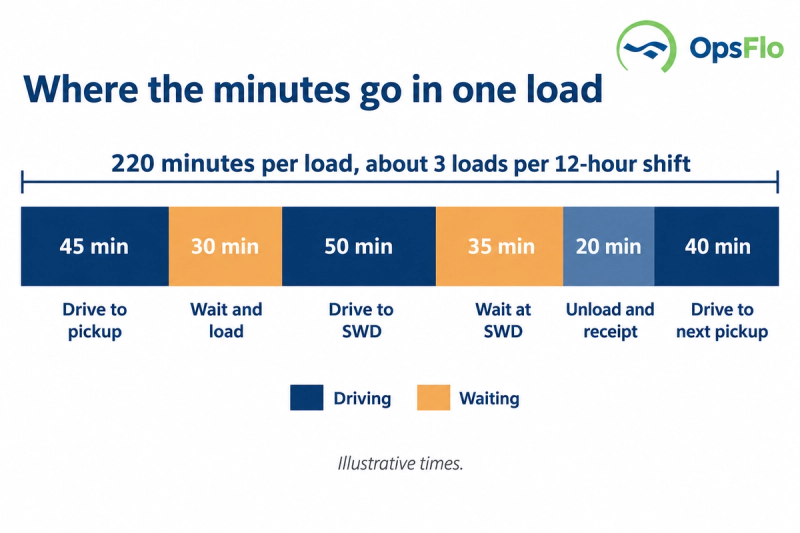
Every load runs through the same six steps. Here's an illustrative produced water run in the Permian:
- Dispatch to arrival at pickup: 45 minutes. Lease roads, gates, and finding the right battery.
- Wait and load: 30 minutes. Gauging the tank, hooking up, pulling the load.
- Drive to the SWD: 50 minutes.
- Wait in line at the SWD: 35 minutes. The step nobody controls and everybody pays for.
- Unload and get the receipt: 20 minutes.
- Drive to the next pickup: 40 minutes.
That's 220 minutes, or a little over three loads in a 12-hour shift. Cut 30 minutes of waiting from each cycle and the same truck runs close to four loads a day.
The drive times are mostly fixed. The waits aren't. Disposal lines, tanks that aren't ready, and drivers sent to the far side of the county are where a dispatcher can actually win time back.
What belongs on a hauling run ticket
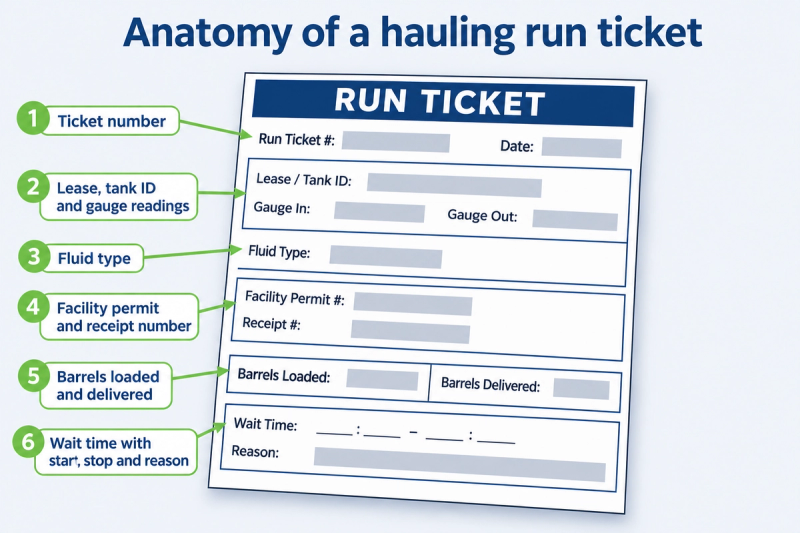
The run ticket is how a load becomes an invoice line. If it's incomplete, the load is either billed wrong or not billed at all. A good one covers both ends of the trip:
- Ticket number. Sequential, so a missing number means a missing load.
- Truck, trailer and driver.
- Customer and requester. The operator, and the person who called for the load.
- Pickup. Lease name and number, tank or battery ID, gauge readings before and after if you load from a tank, and time in and out.
- Fluid type. Produced water, flowback, fresh water, brine, or other.
- Delivery. Facility name and permit number, receipt number, and time in and out.
- Volume. Barrels loaded and barrels delivered.
- Billing. Hours, loads or barrels as the MSA sets them, wait time at each end with the reason, and disposal fees passed through.
- Customer reference. PO, AFE or cost center.
- Signatures. Driver, plus the customer's representative where the operator requires one.
Two things matter most. The barrels on the ticket should match the barrels on the disposal receipt, and wait time needs a start, a stop and a reason written down on location. When either one is missing or doesn't match, it's the first line a customer questions.
Manifests, SWD receipts and chain of custody
In Texas, the paperwork changed in 2025. The Railroad Commission's new Chapter 4 waste rules, effective July 1, 2025, require oil and gas waste hauled off the lease by vehicle to travel with a manifest, either on paper or in an electronic system the Commission and every party can reach. Produced water counts as oil and gas waste.
Operators can use the Commission's form or their own, as long as it carries at least:
- The generator's name, operator number and contact details.
- The lease name and number, facility name and number (or latitude and longitude), and county.
- The generator's waste profile identifier.
- The receiving facility and its permit identifier.
- The hauler's name and waste hauler permit number, with the driver's signature.
- The type and volume of waste.
- The shipment date, and the generator's name and signature.
- The date of acceptance and the receiving facility's signature.
The generator, the hauler and the facility each keep copies for three years. The rule also covers the trucks: each one needs the hauler's name and permit number on both sides and the rear in letters at least three inches high, and must carry a copy of the permit with its approved vehicle list. The permit runs for a year at most and has to be renewed.
The SWD receipt is the other half of the chain. It's the facility's record that it took your load: its name and permit number, the date and time, the volume, and your truck and driver. Many disposal operators also run electronic ticketing. Either way, the receipt number belongs on your run ticket, and a photo of the receipt belongs with it before the driver pulls away.
When the manifest, the run ticket and the SWD receipt all show the same lease, the same facility and the same barrels, nobody argues about the load. When they don't, Texas expects the receiving facility to report significant discrepancies to the Commission, the generator and the hauler.
Outside Texas, the rules and forms differ, so check your state's oil and gas regulator before you build your paperwork around this list.
Legal load vs money load: the 120-barrel problem
A 130-barrel trailer doesn't always haul 130 barrels legally. In Texas, the legal limits are 80,000 pounds gross, 20,000 pounds on a single axle and 34,000 on a tandem group. How many barrels fit under that depends on two things: what your rig weighs empty, and what the fluid weighs.
Fresh water weighs about 350 pounds a barrel. Permian produced water carries a lot of dissolved salt, often around 90 to 100 grams per liter according to research cited by New Mexico's Environment Department, which puts it closer to 375 pounds a barrel. Here's what that does to a legal load:
- Rig weighing 30,000 lb empty: about 142 barrels of fresh water, or 133 barrels of salty produced water.
- Rig weighing 32,000 lb empty: about 137 barrels of fresh water, or 128 barrels of salty produced water.
- Rig weighing 34,000 lb empty: about 131 barrels of fresh water, or 122 barrels of salty produced water.
So a heavier rig hauling heavy brine tops out in the low 120s. A full 130 barrels of that water on a 32,000-pound rig puts you around 80,700 pounds gross, before you check how the weight sits on each axle.
To work out your own number, weigh each rig empty on a certified scale, subtract that from 80,000, and divide by the weight per barrel of the water you actually haul. Then confirm the axle weights on a loaded run. Put the result on the dispatch board for each truck and customer, so drivers know the legal barrel count before they hook up.
The legal count also belongs in your pricing. If you bill per barrel, a smaller legal load means more trips, more fuel and more driver hours for the same volume. If you bill per load, price the load on what the truck can legally carry for that customer's water, not on the trailer's nameplate.
DOT inspections and hours of service
Inspections
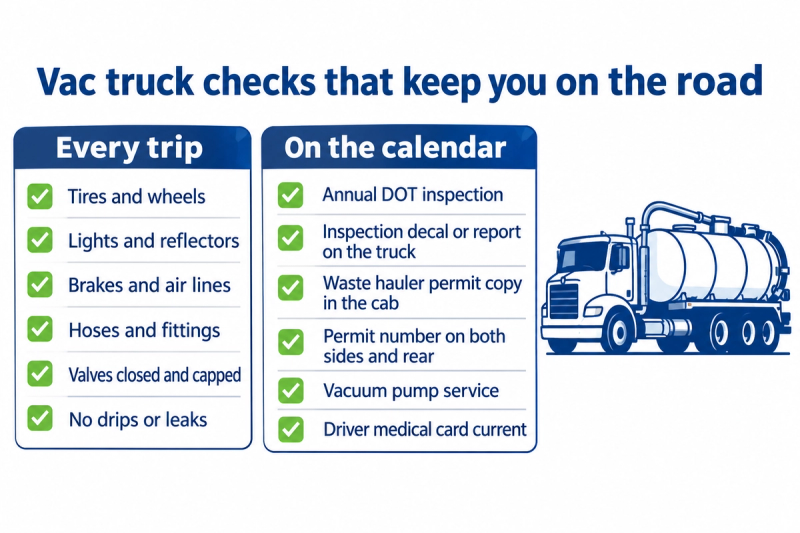
Under 49 CFR 396.17, every commercial motor vehicle needs a periodic inspection at least once every 12 months, with proof of it on the vehicle: the inspection report itself, or a sticker or decal showing the date, who keeps the report, and the vehicle it covers. A vac truck adds its own wear points on top of the standard list: the vacuum pump, hoses and fittings, valves, the tank shell, and the seals that keep the load where it belongs. Texas makes that last part a permit condition, requiring haulers to operate and maintain vehicles to prevent spills and leaks.
If you also haul crude or condensate in a DOT-specification cargo tank, that tank carries its own federal test schedule. Check it with your tank inspector separately.
Hours of service
For interstate property carriers, the federal rules in 49 CFR 395.3 allow 11 hours of driving inside a 14-hour window after 10 hours off duty, with a 60-hour or 70-hour limit over 7 or 8 days.
Oilfield work gets two exceptions under 49 CFR 395.1(d), and the second one is easy to misread:
- The 24-hour restart. Drivers of vehicles used exclusively to haul oilfield equipment or service oil and gas field operations can restart their 8-day period after 24 hours off duty, instead of the usual 34.
- Waiting time at the well site. Time spent waiting at a well site doesn't count as on duty, but only for specially trained drivers of vehicles specially constructed to service oil wells. FMCSA's guidance gives examples like wireline trucks, frac pumps and cement pumps, and says plainly that vehicles moving supplies "such as sand and water" don't qualify, even with pumps on board.
In other words, a vac truck driver's time waiting at the tank battery or the SWD line is on-duty time. Build it into your dispatch plan. Carriers that run only within Texas may fall under the state's intrastate rules, which differ, so confirm which set applies with your safety lead.
Dispatch: proximity, disposal windows and driver hours
A hauling dispatcher is solving the same puzzle all day: which truck, to which tank, then to which disposal. Good dispatch weighs four things at once:
- Proximity. The nearest empty truck, not the driver who answered the phone first.
- Tank readiness. Send the truck when the tank is ready to pull, not when the pumper first calls.
- Disposal windows. Which SWDs are open, which have a line right now, and which one the customer's contract requires.
- Driver hours. A driver with two hours left on the 14-hour clock shouldn't get a run that needs three.
A whiteboard and a phone can handle that with four trucks. At twelve, the dispatcher needs to see where every truck is, how far each one is from the next pickup, and how many hours each driver has left, all on one screen.
Short loads and partial loads
A short load is a full trip carrying less than the truck can legally haul. The tank wasn't ready, the timing was off, or the driver was sent before anyone checked. Fuel, driver time and wear are all spent, but the load earns less. In FieldEquip's illustrative example, revenue per haul falls 15% on a day when 5 of 14 trucks run short.
Short loads hide on paper because each one looks normal on its own ticket. Compare barrels hauled against each truck's legal load every week, and they show up quickly. Then check whether your MSA allows a minimum charge per load. If it does, every short load billed below that minimum is money left behind.
The numbers worth watching every week
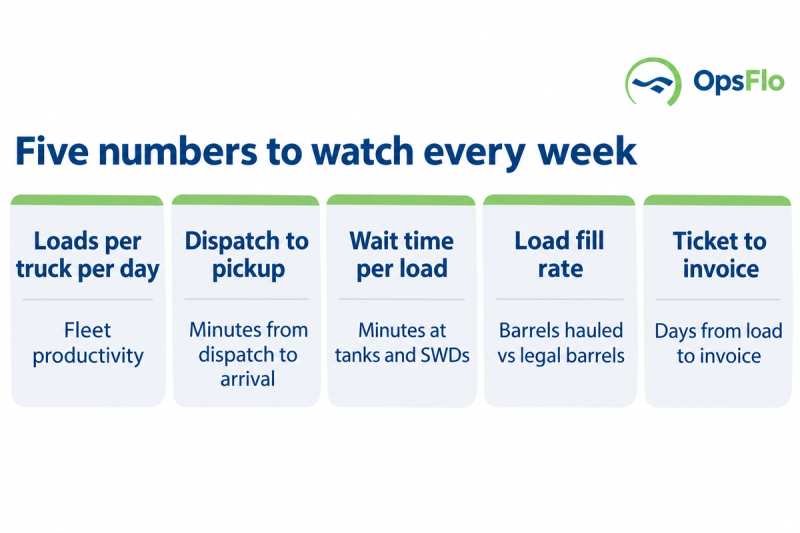
Five numbers tell you most of what you need to know about a hauling operation:
- Loads per truck per day. Shows fleet productivity. Divide completed loads by the number of trucks working, then by the number of days.
- Dispatch to pickup time. Shows how good your dispatch and truck placement are. Measure the average minutes from dispatch to arrival at the tank.
- Wait time per load. Shows the hours lost at tanks and disposal lines. Add the minutes waiting at pickup to the minutes in line at the SWD.
- Load fill rate. Shows how often trucks run short. Divide barrels hauled by the legal barrels for that truck and fluid.
- Ticket to invoice time. Shows how fast loads turn into cash. Measure the days from load completion to invoice sent.
Track them by truck, by driver and by customer. The averages tell you how the fleet is doing. The outliers tell you where to look.
Where OpsFlo fits
OpsFlo runs the hauling day from dispatch to invoice. Dispatchers see who's free on the Planner, assign loads by hand or automatically, and follow every truck on a live map with its distance and ETA to the next job, with a text alert when a truck runs late. Telematics devices such as Samsara feed in location and engine hours.
Drivers complete the run ticket in the OpsFlo app, which works offline on lease roads. Required fields and photos, including the SWD receipt, have to be in before the ticket can be submitted. Truck documents, inspections and services due from engine hours and miles are tracked in the same system. Each ticket becomes an invoice that syncs to QuickBooks, NetSuite, Acumatica or another ERP.
One fluid hauling company with 38 vacuum trucks used OpsFlo to find $890,000 in loads that were never billed in its first year, and lifted its load-to-invoice match rate from 87% to 99.4%.
See dispatch and per-load ticketing for hauling fleets
Book a demo and we'll walk through a day of hauling in OpsFlo, from dispatch to the signed run ticket to the invoice.
See how OpsFlo works for fluid hauling → /solutions/fluid-hauling
Frequently asked questions
What is a run ticket in water hauling?
It's the driver's record of one load: the truck and driver, the lease and tank it came from, the fluid type, the barrels, the disposal facility and its receipt number, times at each end, and any wait time. It's what the hauling company invoices from, so a missing or incomplete run ticket usually means a load that's billed wrong or not at all.
How many barrels can a vac truck legally haul?
It depends on the rig's empty weight and the fluid. Texas allows 80,000 pounds gross. Fresh water weighs about 350 pounds a barrel and salty Permian produced water about 375. A rig weighing 32,000 pounds empty can legally haul about 137 barrels of fresh water but only about 128 of heavy produced water. Weigh each rig and check axle weights to set its own number.
What is an SWD receipt?
It's the saltwater disposal facility's record that it accepted your load, showing the facility and its permit number, the date and time, the volume, and your truck and driver. Its number should go on your run ticket so the load, the manifest and the receipt all tie together.
Do oilfield truck drivers have hours-of-service exemptions?
Two federal exceptions apply. Drivers serving oil and gas field operations can restart their 8-day period after 24 hours off duty instead of 34. Waiting time at a well site doesn't count as on duty only for specially trained drivers of specially built well-service vehicles, and FMCSA says vehicles hauling water and sand don't qualify.
How do hauling companies bill per load?
The MSA sets the unit: per load, per barrel, or per hour, often with a minimum charge per load and a rate for wait time. Disposal fees are usually passed through from the SWD receipt. Whatever the unit, the run ticket has to carry the data behind it: barrels, times, wait time and the receipt.
Related reading
- What Is a Field Ticket? The Complete Guide for Oilfield Service Companies
- Revenue Leakage in Oilfield Services: The Seven Places 2-5% of Your Revenue Disappears
- AI-Powered Dispatch: How Smart Crew Assignment Is Reshaping Oil & Gas Operations
- Fluid Hauling
- Inspections
Sources
- Railroad Commission of Texas, 16 TAC Chapter 4, Subchapter A (effective July 1, 2025): §4.191 manifests, §4.193 waste haulers, §4.194 recordkeeping.
- Railroad Commission of Texas, Waste Haulers: who needs a waste hauler permit, and produced water as oil and gas waste.
- Texas Department of Motor Vehicles, Texas Size/Weight Limits: gross, single axle and tandem limits.
- New Mexico Environment Department, Spatiotemporal Analysis of Produced Water Demand: Permian produced water salinity.
- eCFR, 49 CFR 396.17: periodic inspection.
- eCFR, 49 CFR 395.3 and 49 CFR 395.1(d): hours of service and oilfield exceptions.
- FMCSA, guidance on the 395.1(d)(2) waiting-time provision.
- FieldEquip, How Short Loads Are Quietly Draining Profit From Your Oilfield Logistics Operation (2026).
No comments yet
Be the first to share your thoughts.
Leave a Reply
Your email address will not be published. Required fields are marked *