AI-Powered Dispatch: How Smart Crew Assignment Is Reshaping Oil & Gas Operations
Why dispatchers are operating without radar, and what changes when you give them AI-powered visibility.
In oilfield operations, dispatch is one of the most cognitively demanding jobs in the company. The dispatcher has to balance:
- Customer location and urgency
- Crew availability and rotation status
- Certifications required for specific jobs
- Equipment readiness across multiple yards
- Travel time between sites
- Driver hours-of-service limits
- Weather conditions
- Customer preferences and history
…all in real time, often over the phone, while the next call is already ringing.
Most companies do this with a whiteboard, a few spreadsheets, and a dispatcher’s accumulated experience. It works at small scale. It breaks completely past a certain point.
That breaking point comes earlier than most companies realize.
The cost of manual dispatch isn’t visible until it is
The hidden costs of manual dispatch show up in places no one connects to the dispatch function:
Mobilization delays that stack up.
The crew was loaded with the wrong gear because the dispatcher didn’t catch the certification mismatch. By the time it’s spotted, the crew is 40 miles down the road. Two hours lost.
Jobs declined that could have been accepted.
A crew in District 2 finished early. The dispatcher in District 3 doesn’t know because they’re focused on their own queue. A job that could have been swung is turned down. Revenue walks away.
Wrong crew for the job.
A premium PLT run gets assigned to a crew without the specific tool certifications. By the time the customer arrives on-site, the swap has to happen. Customer satisfaction drops. Standby time accrues.
Dispatcher burnout.
The two dispatchers at most oilfield services companies are working 55-65 hour weeks. They’re firefighting, not optimizing. Turnover in the role runs at 35% annually.
None of these costs show up on the dispatch report. They show up as missed revenue, NPT, customer complaints, and HR problems, and they trace back to dispatch having no radar.
What AI-powered dispatch actually does
The mistake most companies make when they hear “AI dispatch” is to assume the AI is going to replace the dispatcher. That’s not what happens.
What happens is the AI gives the dispatcher the picture they always needed.
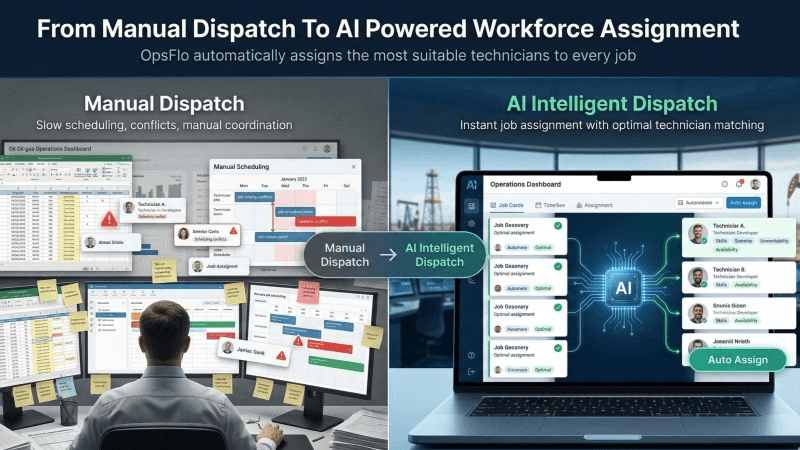
Here’s what AI-powered intelligent dispatch does in practice:
Real-time crew availability across all districts.
Not “should be available based on the schedule,” actually available, right now, based on current job status, location, and capacity. The dispatcher can see a crew in another district that finished early before that crew’s own supervisor knows.
Skills-and-certifications matching.
Every crew has a certification profile. Every job has certification requirements. The system suggests crews whose certifications match the job, ranked by proximity, availability, and customer history. Mis-matches that used to happen monthly stop happening.
Equipment readiness verification.
Before suggesting a crew, the system verifies that the equipment they have on hand matches the job. No more dispatching a crew that has to swing by the yard for the right tools.
Travel time and routing optimization.
The system knows the road network. It knows the current locations of every crew. It calculates actual ETAs, not estimates. Customers get accurate arrival times for the first time.
Continuous learning.
Every completed job feeds the system more data. Customer preferences, job patterns, crew strengths, equipment performance: the dispatch decisions get smarter over time without anyone retraining anything.
What the dispatcher does now
With AI-powered dispatch, the dispatcher’s role changes. They’re no longer doing rote matching of crews to jobs. The system handles 80-90% of assignments automatically.
What the dispatcher does instead:
- Handles exceptions and edge cases
- Manages customer-specific relationships
- Coordinates across multiple dispatch decisions
- Optimizes at a higher level
The dispatcher becomes a strategist instead of an air traffic controller. The same two-person dispatch team that was at capacity at 40 crews can now manage 120.
Results from the field
Companies that have implemented AI-powered intelligent dispatch typically see:
- 40-50% reduction in crew mobilization delays
- 2-3x increase in jobs completed per crew per week (driven primarily by less idle time)
- 15-25% reduction in dispatcher overtime
- Significantly improved customer NPS due to accurate ETAs and reduced surprises
These aren’t projections. They’re outcomes documented across real deployments.
The shift to make
If your dispatch operation is showing strain (long hours, missed jobs, frustrated customers, frustrated crews) the answer isn’t to hire another dispatcher. The answer is to give the dispatchers you have the visibility they need to operate at scale.
That’s what AI-powered dispatch makes possible.
Want to see how OpsFlo’s Intelligent Dispatch would work for your operation? Book a 20-minute walkthrough. We’ll show you how the system handles your specific crew structure, geography, and customer mix.
No comments yet
Be the first to share your thoughts.
Leave a Reply
Your email address will not be published. Required fields are marked *