

Margins Just Turned Positive. Why Oilfield Service Companies Still Aren't Celebrating
For the first time in several years, oilfield service companies in Texas and southern New Mexico reported that their margins expanded.
That is not a forecast or a vendor claim. It is what 45 oilfield services firms told the Federal Reserve Bank of Dallas in June. The Q2 2026 Dallas Fed Energy Survey put the operating margin index at +52.2, up from −7.0 the previous quarter. Prices received for services rose from 9.3 to 24.5. Equipment utilization stayed positive. Business activity across the sector hit its strongest reading since mid-2022.
And in the same survey, those same companies rated their own outlook at −4.4.
Negative. While E&P firms rated theirs at +48.2.
That gap is the most interesting number in the energy sector right now, and it is worth understanding if you run a service company — because it says something specific about where your margin actually comes from.

Why the good quarter doesn't feel like one
Look at what moved underneath the margin number.
Input costs rose far faster than prices. The oilfield services input cost index hit 64.4, up from 34.9 — with not a single respondent reporting costs going down. Prices received rose too, but only to 24.5. Costs are climbing at roughly two and a half times the rate of prices.
One respondent laid out the arithmetic directly:
"Business activity has increased in the second quarter of 2026 compared to both the prior quarter and the same period last year, driven by stronger demand for rental equipment and field services in the Midland and Delaware Basins. However, diesel fuel costs have risen sharply — up approximately 65 percent since January. This input cost pressure is partially offsetting strong revenue growth."
That is the quarter in one paragraph. More work, more revenue, and a fuel bill that ate a large share of it.
The pricing power is uneven and contested. Some firms are getting rate increases. Others are watching them get bid away:
"As a service provider, we have seen pricing that has become much more competitive with the consolidation of the majors. We are seeing smaller service providers come in and slash pricing to unrealistic numbers. The majors are accepting these price cuts temporarily until they start to experience service problems and failures."
And the blunt version, from a firm that cannot pass its costs through at all:
"Fuel expenses have greatly increased over the past quarter, but equipment pricing is not keeping up with inflation. E&P consolidation has made an impossible environment to pass on ever increasing costs."
The labor market is tightening against you. Two comments from the same survey:
"Competition for experienced field crews is increasing, and customers are hiring our people."
"With higher activity, the labor market has begun to tighten (must be legal to work in U.S. and pass drug test, which screens out a lot of applicants), and thus the market for services has tightened slightly."
And the whole quarter rests on a geopolitical premium nobody trusts. WTI averaged $87.27 during the survey window, inflated by the Iran conflict. Respondents' own year-end forecast was $80.55. Several said plainly they expect prices to fall back once hostilities settle. Activity built on a war premium is activity with a short and uncertain lease.
So: margins expanded, and almost nobody believes the conditions that produced them will hold. Hence −4.4.

What this actually means for your operation
Here is the practical read, and it is not the obvious one.
When prices are rising, margin improvement is easy to attribute to the market and easy to lose when the market turns. The companies that come out of a window like this in better shape are the ones that use it to fix the things that will still be broken at $65 oil.
Three specifics.
1. Your cost per job is now moving faster than your rate sheet. Diesel up 65% since January means the rate you negotiated in your MSA last year is quietly worth less on every job. If your rate exhibit has a fuel surcharge mechanism, this is the quarter to actually use it — one respondent noted surcharges "went into place in April in all markets." If it does not, that is a contract conversation to have now, while activity is strong and you have leverage, not in Q1 when it isn't.
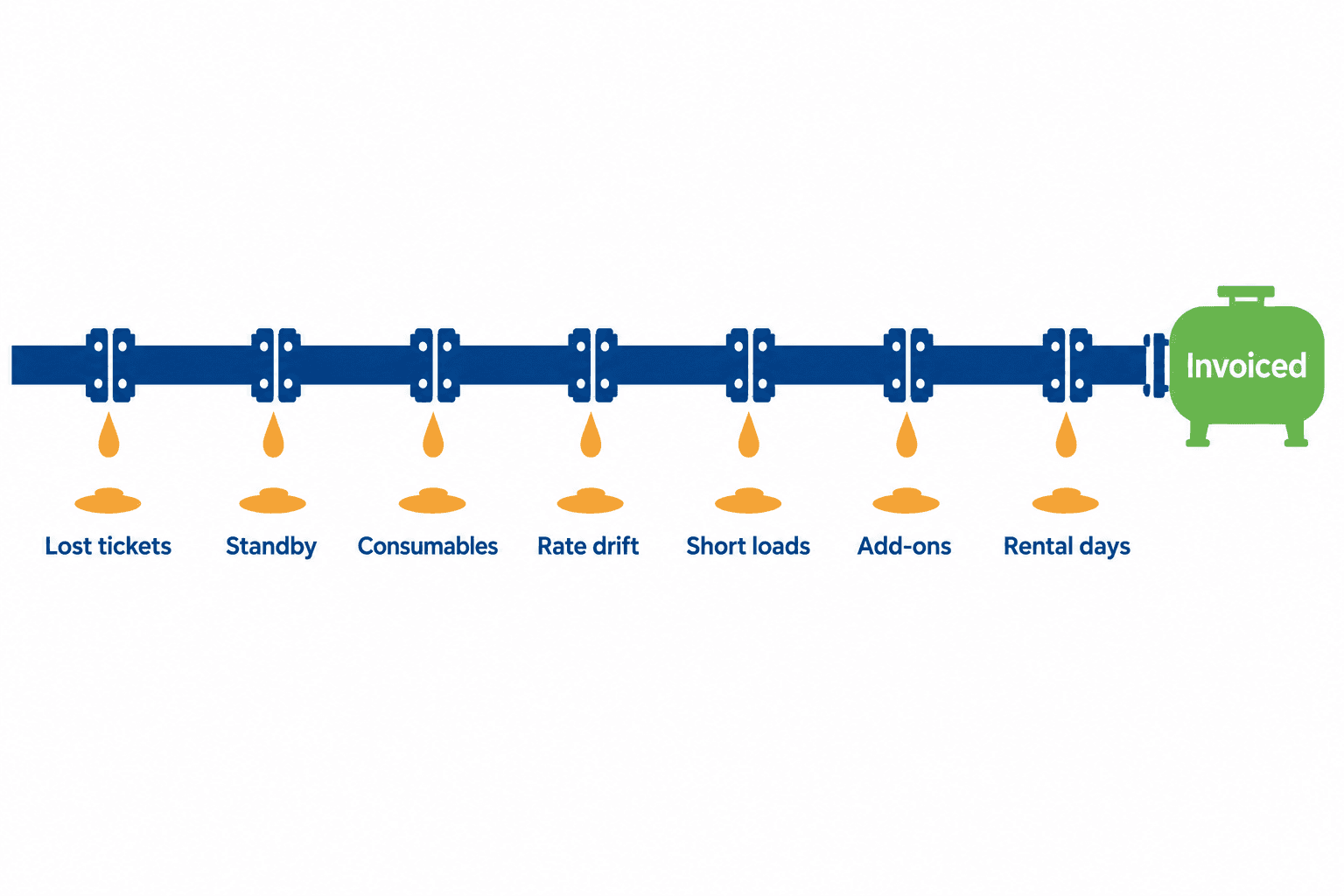
2. Every hour you work and don't bill is worth more than it was six months ago. This is the part that gets missed. When your input costs jump 65% and your prices rise 24%, the gap between work performed and work invoiced stops being an administrative annoyance and becomes the difference between a profitable job and a break-even one. Standby that never made it onto a ticket. A rental that stayed on location four days after the job closed. Consumables nobody recorded. At last year's cost base, that leakage was painful. At this year's, on jobs where fuel alone is up two thirds, it decides whether the job made money.
3. Utilization is where the margin actually came from. The equipment utilization index was 31.9 and the activity index 42.3 for services firms. Margins improved substantially because assets worked more, not because rates jumped. That means the levers that matter are the operational ones: how fast you mobilize, how well you match crews and certifications to jobs, and how much of your fleet is earning on any given day.
None of those three depend on the oil price. All three are still worth something in a downturn.

The window
The honest framing is that this is a window, not a recovery.
Costs are rising faster than prices. The activity is partly a war premium. Your customers have consolidated into fewer, larger buyers with more leverage than they had three years ago, and some of your competitors are bidding below cost to hold share. The survey's own respondents put their outlook at negative while posting their best margins in years, and they are not being pessimistic for the sake of it — they are reading the same inputs.
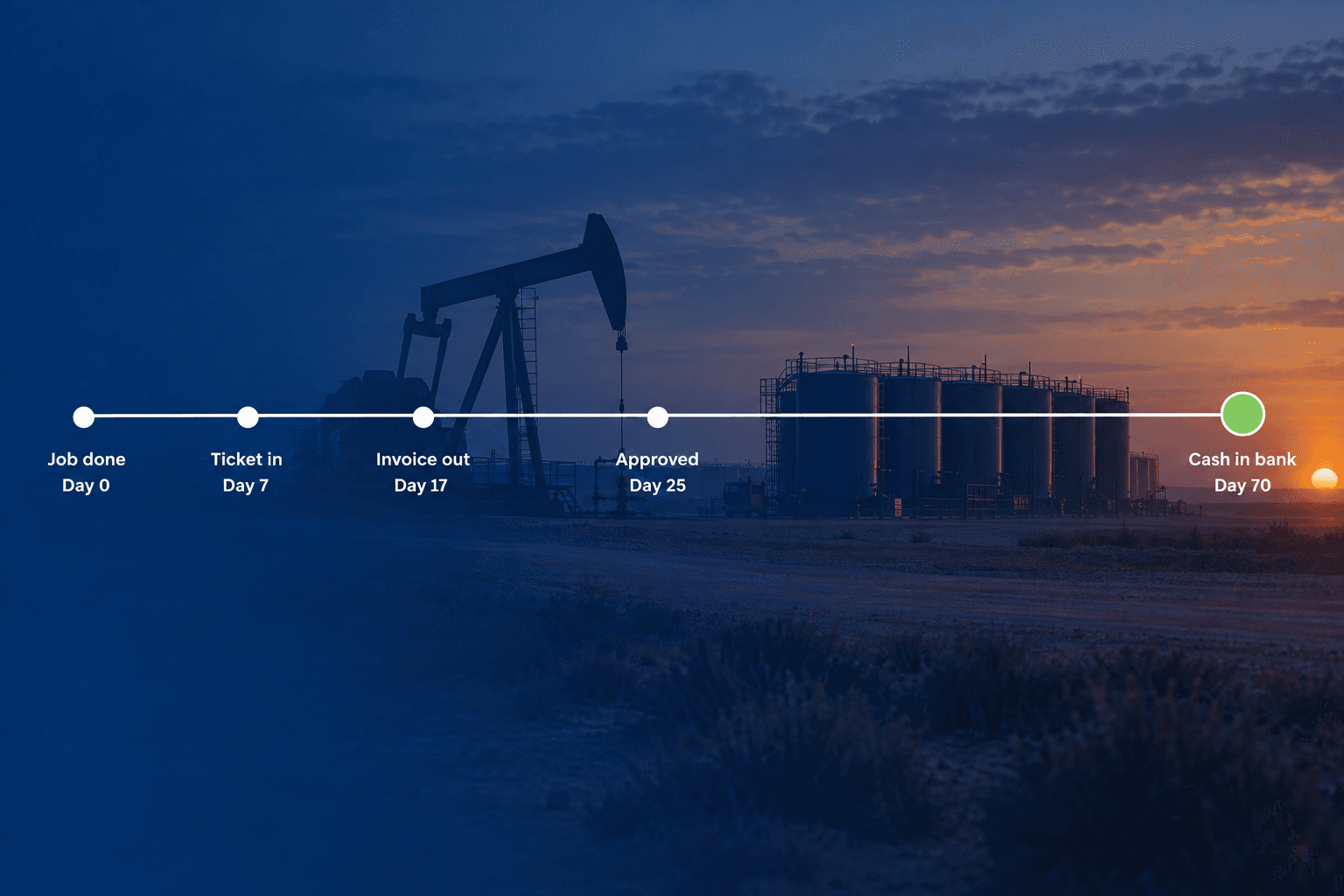
What a window is good for is fixing structural things while you have cash to do it. Rate sheets and surcharge mechanisms. The gap between work done and work billed. How fast a ticket becomes an invoice becomes cash. Utilization and dispatch discipline.
Those are unglamorous. They are also the only parts of your margin that you control rather than receive.
The Q3 survey lands 30 September. Whatever it says, the companies that spent this quarter capturing everything they earned will be in better shape than the ones that spent it hoping $87 oil sticks around.
How much are you earning but not billing?
Most service companies lose a measurable share of revenue to work that was performed and never invoiced — standby that never made the ticket, rental days never closed out, consumables nobody recorded. Our ROI calculator estimates what that is worth on your volume.
Run the numbers → /roi-calculator
Or read how a Permian rental company recovered $1.8M in unbilled revenue → /case-studies/recovered-1-8m-in-hidden-rental-revenue
No comments yet
Be the first to share your thoughts.
Leave a Reply
Your email address will not be published. Required fields are marked *