

The MSA Clauses That Decide Whether You Get Paid (and Your Lien Rights When You Don't)
Most service companies read an MSA for two things: the rates and the insurance. Then they sign, because the work starts Monday.
The clauses that decide whether you actually get paid are usually somewhere else. They set how many days you have to bill, who has to sign a ticket, what happens when the operator disputes a line, and whether you've already given up your lien rights. You find out about them when an invoice goes unpaid, and by then most of them are working against you.
This guide covers what the 2026 Nine Energy bankruptcy taught vendors, the six clauses to read before you sign, how lien rights work in Texas and four other oil states, and how to run operations so the paperwork holds up when it matters.
What Nine Energy taught vendors in 2026
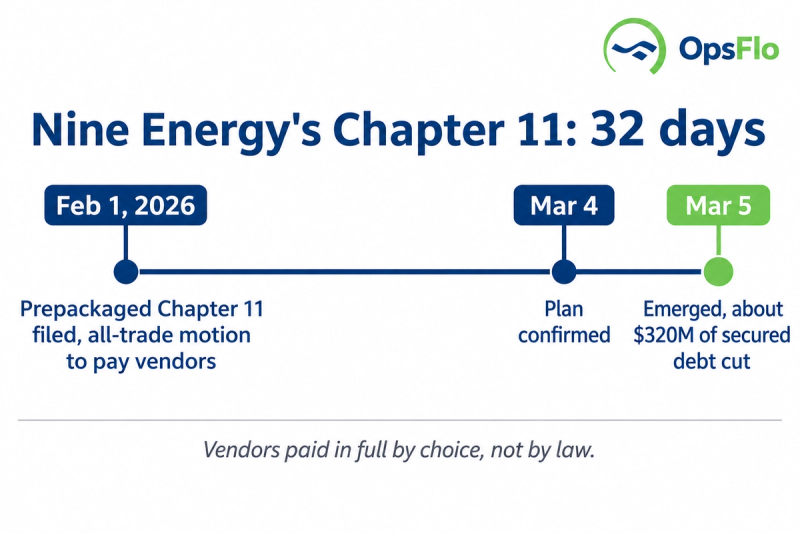
Houston-based Nine Energy Service filed a prepackaged Chapter 11 case in the Southern District of Texas on February 1, 2026. It came with an "all-trade" motion asking the court to let it pay vendors in full for work done before and after the filing. The plan was confirmed on March 4, and the company emerged on March 5, having cut about $320 million of secured debt. The whole process took 32 days.
For Nine's vendors, it was about as good as a customer bankruptcy gets. But as Foley & Lardner's Scott Ellis pointed out in May, paying trade vendors in full was a business decision Nine made, not a legal obligation. In a messier case, a service company with no perfected lien is an unsecured creditor waiting in line.
The same article quotes an oilfield services executive from the Dallas Fed's April 2026 survey: "The low-cost environment is starting to put companies out." Customers under pressure pay slowly first, then stop. The time to check your contracts is before that happens.
The six clauses to read before you sign
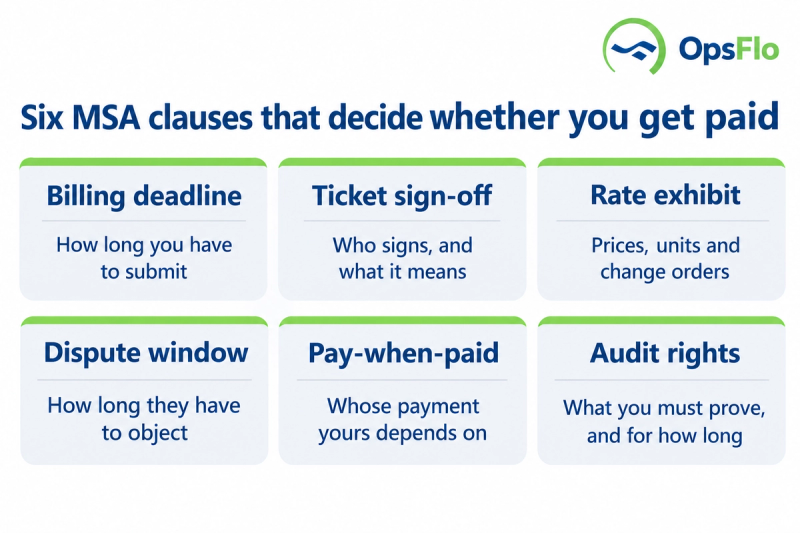
Every operator writes its own MSA, but the same six clauses decide how payment works. For each one, here's what to look for and what it asks of your operation.
1. The billing deadline
Many MSAs and invoicing policies set a window for submitting invoices and support. Equinor's US invoicing policy, for example, wants the signed, stamped field ticket support within 60 days of the work. Some agreements go further and say charges submitted late are waived.
What to look for: the number of days, when the clock starts, and whether a late invoice is reduced, delayed or lost.
What it asks of you: a ticket that reaches the office in days, not weeks, and a way to see which jobs are getting close to the window.
2. Ticket approval and sign-off
This clause says who can sign a ticket for the operator, and what a signature means. Some MSAs treat a signed ticket as acceptance of the work and quantities. Others let the operator review and adjust it later.
What to look for: who is authorized to sign, whether an electronic signature counts, and whether a signed ticket can still be disputed.
What it asks of you: the right person's signature on every ticket, captured on location, with the date and time.
3. The rate exhibit and change orders
The rate exhibit is the price list attached to the MSA. It controls what you can bill, in what units, and with what minimums. Extra work outside it usually needs written approval.
What to look for: units of measure, minimum charges, standby rates, how rate changes take effect, and what counts as an approved change.
What it asks of you: tickets priced from the current exhibit, and extra work written up and signed before the crew leaves.
4. The dispute window
This sets how long the operator has to dispute an invoice, and what happens to the undisputed part. A good clause makes the operator pay the undisputed amount on time and raise any dispute in writing within a set number of days.
What to look for: a deadline for disputes, a requirement that they be in writing and specific, and a duty to pay undisputed amounts on schedule.
What it asks of you: tickets clean enough that a disputed line can be settled quickly, with photos, times and signatures behind it.
5. Pay-when-paid or pay-if-paid
If you work as a subcontractor to a larger contractor, watch for language tying your payment to theirs. "Pay-when-paid" usually affects timing. "Pay-if-paid" can mean you don't get paid at all if the operator never pays the contractor above you. How courts treat these clauses depends on the wording and the state.
What to look for: any clause making your payment depend on someone else's payment.
What it asks of you: knowing who's paying whom on every job, and a lawyer's read on the exact words before you sign.
6. Audit rights
Many operator MSAs let them audit your invoices and records, often for years after the work. An audit can lead to refunds if your records don't support what you billed.
What to look for: how long the audit period lasts, which records you must keep, and whether you can audit their adjustments too.
What it asks of you: records you can pull up for any job, years later: the signed ticket, the rates used, and the photos and times behind each line.
Lien rights: your protection when the money doesn't come
A lien attaches your unpaid bill to the operator's property: the lease, the well, the equipment on it. If the operator goes into bankruptcy, a lien filed beforehand can make you a secured creditor instead of an unsecured one. That's the difference between getting paid from the property and waiting in line.
Texas: the mineral lien
Chapter 56 of the Texas Property Code gives a lien to anyone who performs labor or services for oil and gas work, whether they contract with the property owner (a mineral contractor) or with one of its contractors (a mineral subcontractor). The rules that matter most:
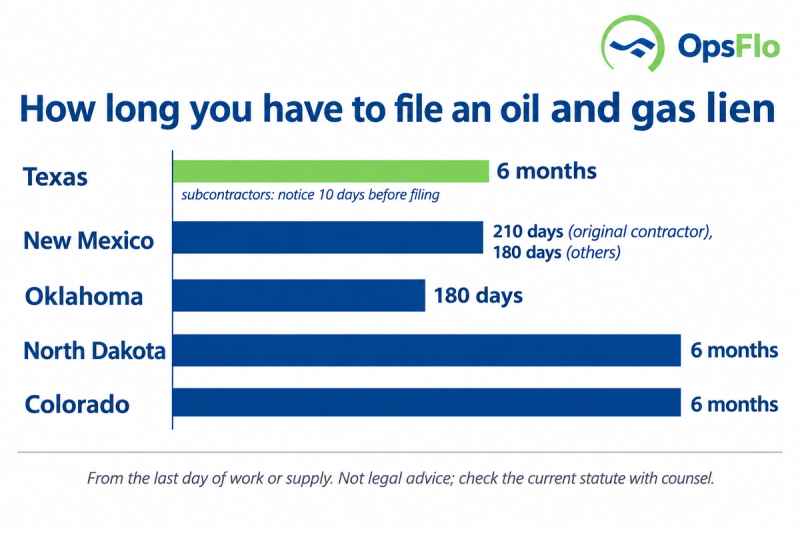
- Six months to file. The lien affidavit must be filed with the county clerk where the property sits, no later than six months after the debt accrues. For materials and services, that's generally the date they were last furnished. The clock starts when the work is done, not when the invoice goes unpaid.
- Ten days' notice for subcontractors. A subcontractor must serve written notice on the property owner at least 10 days before filing. Miss it and the claim fails.
- What the affidavit needs. The owner's name if known, your name and address, the dates of the work, a description of the land, lease or pipeline, and an itemized list of amounts. Subcontractors also name who they worked for and confirm they served notice.
- A deadline to enforce. A filed lien has to be enforced by a lawsuit within the time Texas allows for mechanic's liens, or it's lost.
- The bankruptcy stay. Once a customer files for bankruptcy, the automatic stay generally stops you from filing a lien you hadn't filed yet. A lien only protects you if it's in place before the petition.
Foley's Ellis points out the practical problem: most companies don't escalate until an invoice is 60 to 90 days late. By then, half the six-month window is already gone. He suggests reviewing lien options at 90 days past due, not 120 or 180.
The lien waiver hiding in your MSA
Some operator MSAs waive your lien rights before you ever start work. The waiver can be plain ("waives any and all rights to lien") or quieter, as a "credit reliance" clause saying you rely on the operator's credit and will look only to the operator for payment. In Mesa Southern CWS Acquisition v. Deep Energy Exploration Partners (Houston Court of Appeals, 2019), a credit reliance clause was enforced as a lien waiver. The service company's liens were released and it recovered nothing from the property.
If you see either kind of language, push to remove it, or at least narrow it to amounts disputed in writing within a set time.
Four other oil states at a glance
Each state writes its own oil and gas lien law, with different deadlines and notice rules:
- New Mexico: 210 days after the last labor or materials for an original contractor, and 180 days for everyone else (NMSA 70-4-4).
- Oklahoma: 180 days after materials or supplies were last furnished or labor last performed (42 O.S. §146).
- North Dakota: six months after labor was last performed or materials or services last furnished (NDCC 35-24).
- Colorado: six months after the materials or supplies were furnished or the work performed (CRS 38-24-104).
Notice requirements and enforcement deadlines vary as well. Check the current statute, or better, ask counsel, before you rely on any of these dates.
Make your operation match the contract
A well-written MSA only protects you if your paperwork can prove what it requires. In practice, that comes down to four habits:
- Date and time every ticket. The lien clock, the billing window and the dispute window all count from dates. If your ticket doesn't show when the work started and ended, you're arguing from memory.
- Get the right signature on location. Know who the MSA says can sign for the operator, and get that signature before the crew leaves. A signature collected a week later is harder to get and easier to question.
- Set a submission deadline inside the contract's deadline. If the MSA gives you 60 days, aim for tickets in the office within 2 days and invoices out within a week. The gap is your safety margin.
- Keep the evidence with the ticket. Photos, receipts, standby start and stop times, and change approvals belong attached to the ticket they support, not in a driver's phone or an email thread.
Those same records are what a lien affidavit needs: the dates of the work, where it was done, and an itemized list of what's owed. If you can pull them up for any job in minutes, you can act on a lien in days instead of weeks.
Your pre-signing checklist
Run through this before you sign any new MSA, and again for your largest customers' current agreements:
- How many days do we have to submit invoices, and what happens if we're late?
- Who can sign tickets for the operator, and does an electronic signature count?
- Does a signed ticket count as acceptance, or can it still be adjusted?
- Does the rate exhibit match how we actually price: units, minimums, standby?
- How are extra work and rate changes approved?
- How long does the operator have to dispute, and must they pay the undisputed part on time?
- Is our payment tied to anyone else getting paid?
- How long do audit rights last, and which records must we keep?
- Is there a lien waiver or "credit reliance" clause? Can we remove or narrow it?
- Are we a contractor or a subcontractor on this work, for lien notice purposes?
- Has a lawyer reviewed the payment and lien language?
Where OpsFlo fits
OpsFlo builds the record an MSA asks for as the work happens. Crews complete tickets in the OpsFlo app with arrival and departure times, required photos and the customer's signature on location, and a missing photo or field stops the ticket from being submitted. Every ticket is checked against the customer's rate card before it's billed. A job log records every change, and the signed ticket, with its photos, goes to the customer as a PDF.
That means when a billing window is closing, a dispute comes in, or you need the dates and amounts for a lien affidavit, the answer is already on file.
See how OpsFlo keeps every ticket audit-ready → /platform/field-ticketing
Frequently asked questions
What is an MSA in oilfield services?
A master service agreement is the umbrella contract between an operator and a service company. It sets the terms that apply to every job: rates (usually in an attached exhibit), insurance and indemnity, invoicing and payment rules, dispute handling, audit rights and, sometimes, lien waivers. Individual jobs then run under work orders or tickets that follow those terms.
How long do I have to file a mineral lien in Texas?
Under Texas Property Code Chapter 56, the lien affidavit must be filed no later than six months after the debt accrues, which is generally when you last furnished the work or materials. A subcontractor must also serve written notice on the property owner at least 10 days before filing. Talk to counsel well before the deadline.
What is pay-when-paid?
It's a clause, common when you work for a contractor rather than the operator, that ties your payment to the contractor being paid. Pay-when-paid usually affects timing. Pay-if-paid can make payment depend on the contractor being paid at all. How enforceable either one is depends on the exact wording and the state.
Can an operator reject a ticket after signing it?
It depends on the MSA. Some treat a signed ticket as acceptance of the work and quantities. Others keep the operator's right to review, adjust or audit later. Read the sign-off and dispute clauses together, and keep photos, times and approvals with every ticket so a challenged line can be supported.
What happens to unpaid invoices when a customer files Chapter 11?
The automatic stay stops collection, including filing new liens. Vendors with liens filed before the petition are generally secured creditors. Others are usually unsecured unless the debtor chooses to pay trade vendors, as Nine Energy did in 2026. That was a business decision, not a guarantee.
Related reading
- Twelve Reasons Operators Reject Oilfield Invoices, and the Ticket-Level Fix for Each
- DSO Benchmarks for Oilfield Service Companies, 2026 Edition (with Calculator)
- Revenue Leakage in Oilfield Services: The Seven Places 2-5% of Your Revenue Disappears
- Field Ticketing
Sources
- Nine Energy Service, press release, February 2, 2026: prepackaged Chapter 11 filing and the all-trade motion.
- Nine Energy Service, press release, March 5, 2026: plan confirmation, emergence and debt reduction.
- Scott D. Ellis, Foley & Lardner, "The Clock Is Already Running on Your Right to Get Paid", National Law Review (May 12, 2026): Texas lien practice, the Mesa Southern case and the Dallas Fed quote.
- Texas Property Code, Chapter 56: mineral contractor and subcontractor liens.
- New Mexico Statutes, Chapter 70: §70-4-4.
- Oklahoma Statutes, Title 42: oil and gas well liens.
- North Dakota Century Code, Chapter 35-24.
- Colorado Revised Statutes, Title 38: §38-24-104.
- Equinor, US Operations Invoicing Policy Standard: 60-day window for signed support.
This article is general information, not legal advice.
No comments yet
Be the first to share your thoughts.
Leave a Reply
Your email address will not be published. Required fields are marked *