


Fluid-End Life by Hours and Barrels Pumped: Predictive Maintenance for Frac Fleets Without Sensors
Ask a frac crew how many hours their fluid ends get and you'll hear a number. Ask how they know, and the answer usually gets vague.
That gap is expensive. A fluid end is the costliest consumable on a frac spread, and when one fails in the middle of a stage, the whole spread can stop. Most fleets still run maintenance on the calendar or on gut feel, and many assume the only way to do better is a sensor project.
It isn't. Your tickets and treatment reports already record most of what wears a fluid end out: pumping hours, stages, pressure and proppant. This guide covers what kills fluid ends, realistic life ranges, how to turn the data you have into inspection triggers, and what a mid-stage failure really costs.
What kills fluid ends
A fluid end takes a pounding on every stroke. In a 2018 Hart Energy techbook article, fluid-end maker Kerr Pumps explains that stress inside the block, where the bores intersect, climbs steeply once treating pressure passes about 8,500 psi. Sand and corrosive fluids add wear and speed up cracking. Kerr's "Five Failures of Fluid Ends" lists the common ways they die:
- Fatigue cracking. Cracks start at the intersecting bores and grow with every pressure cycle. Corrosion makes it worse. A cracked block is done.
- Packing bore washout. Packing wears a washboard pattern into the bore until it can't seal. In the techbook article, Kerr puts this at roughly 40% of fluid-end failures.
- Suction seal bore wear. Sand trapped in the sealing area grinds the bore as the pump pulses.
- Valve seat washout. High-pressure fluid cuts through where the valve seat sits, and changing seats often can damage the taper.
- Discharge seal bore wear. The discharge plug seal rubs the bore, and tools used on valve seats can scar it.
Longer-lasting stainless blocks have brought two more modes to the surface: thread cracking at the suction retaining nut, and stress cracking at the connecting flange.
Maintenance matters as much as metallurgy. Kerr notes that a fluid end can fail in two hours if a packing greaser stops working.
How long fluid ends last
There's no single answer, but the published ranges give you a frame:
- Older carbon steel at high pressure: about 150 to 250 high-pressure pumping hours, according to Kerr, before the industry moved to stainless steel around 2013.
- Traditional fluid ends in general: 100 to 500 actual pumping hours, per Kerr's failures page.
- Modern stainless blocks: can run 2,000 hours or more. SPM Oil & Gas says its EXL fluid end lasts more than 2,500 hours in the field.
- Valves and seats: far shorter. Kerr puts valve changes at 25 to 35 hours of harsh pumping, and seat changes anywhere from 40 to 100 hours.
Two cautions. First, these are manufacturers' figures, so treat the top of each range as best case. Second, "hours" is slippery. Kerr points out that high-pressure pumping time is often closer to 20% of engine hours, not the 80% some crews assume. If you count engine hours, your life numbers will be badly inflated.
The data you already have
You don't need a sensor on every pump to start. Between your field tickets, stage sheets and treatment reports, you already record most of what wears a fluid end:
- Pump unit on each stage. Which pumps were on line, stage by stage.
- High-pressure pumping time. Start and end of pumping for each stage, not engine run time.
- Treating pressure. Average and maximum for each stage.
- Barrels pumped. Total fluid per stage, which tracks the number of strokes.
- Proppant. Pounds pumped and concentration.
- Maintenance events. Valve and seat changes, packing jobs, greaser problems, swaps.
The missing piece is usually one field: the fluid-end serial number. Fluid ends move between pumps. When one is swung off for repair and comes back later, its hours are easy to lose, and Kerr notes that crews often end up guessing. Record the fluid-end serial on every stage sheet and every swap, and each block builds its own history.
Build trigger bands from that data
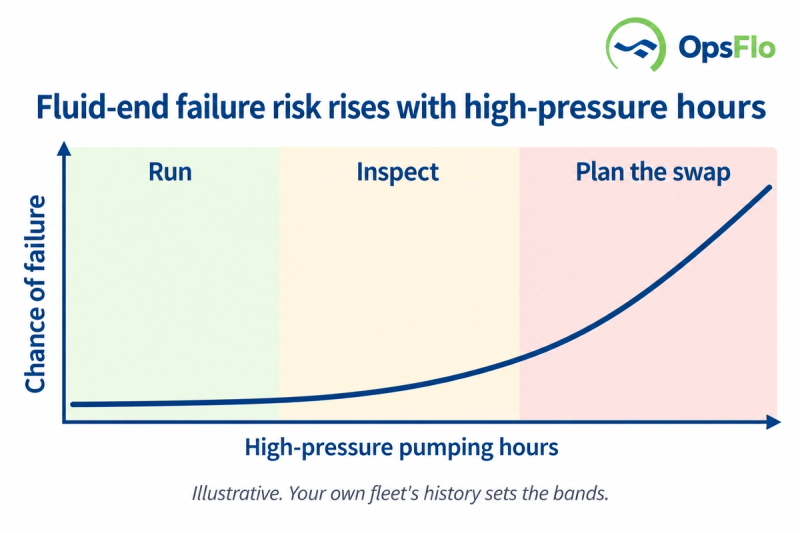
Once each fluid end has a running total, you can set triggers on it. Start with three counters per fluid end:
- High-pressure hours. Real pumping time from your stage sheets.
- Hours at high pressure. The share of those hours above your high-pressure line, such as 8,500 psi, where Kerr says bore stress climbs fastest.
- Proppant pumped. Total pounds, as a measure of abrasive wear.
Then set your bands from your own history, not someone else's brochure. A simple way in:
- Find your baseline. Pull every fluid end you've retired or repaired in the last year or two, and work out the median high-pressure hours each one reached.
- Set an inspection trigger. For example, a full inspection of bores and threads at about 60% of that median.
- Set a planning trigger. For example, schedule the swap between stages or jobs at about 85% of that median.
- Weight the hard hours. Count hours above your high-pressure line, and stages with heavy proppant, as more than one hour each, and see whether that brings your triggers closer to when failures actually happened.
- Keep valves and seats on their own clock. They wear out many times faster than the block, so track them on separate, shorter counts.
Those percentages are starting points, not rules. Review them every quarter against the failures you actually had, and move them up or down. The point is to replace the swap you made after a failure with one you planned between stages.
What a mid-stage failure costs
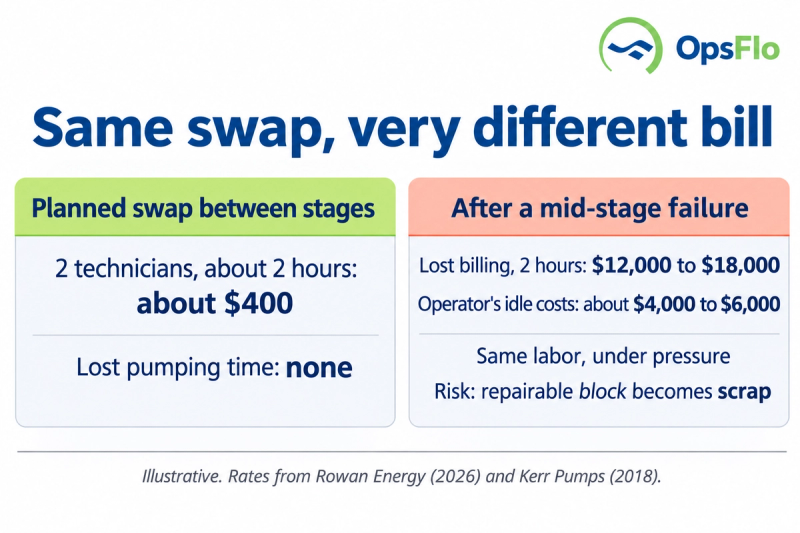
You'll replace the fluid end either way. The question is whether you swap it on your schedule or the pump picks the moment for you. Here's an illustrative comparison using published figures.
The planned swap, between stages or jobs:
- Two technicians for about two hours, the swap time Kerr describes. At the $100 an hour fully burdened rate Kerr uses, that's about $400 in labor.
- No lost pumping time, because the spread isn't waiting on it.
The same swap after a mid-stage failure, with two hours of downtime:
- Lost billing. Rowan Energy puts a working spread's billing at $6,000 to $9,000 an hour. Two hours down is $12,000 to $18,000 that never gets billed.
- The operator's idle costs. Rowan also puts a 15 to 20 pump operation's fixed costs at $50,000 to $75,000 a day. Two idle hours is roughly $4,000 to $6,000 of the operator's money, and a customer relationship problem on top.
- The same two hours of labor, at night, in a hurry.
- Possibly a worse repair. A block you could have weld-repaired, which Kerr prices at about $5,000 per bore, may instead be cracked beyond saving. Kerr's 2018 price for a replacement fluid end was $62,000.
So one failure that a planned swap would have avoided can easily cost $16,000 to $24,000 in downtime alone, before any parts. Across a fleet running dozens of fluid ends, a few avoided failures a year pays for a lot of record keeping.
From trigger to work order
Triggers only help if someone acts on them before the pump does. The flow that works:
- Counters update from the stage sheet. Each completed stage adds hours, pressure time and proppant to the fluid ends that were on line.
- A trigger creates a due item. When a fluid end crosses its inspection or planning band, it shows up on the maintenance due list automatically.
- The due item becomes a work order. Assign it to a mechanic for the next gap between stages or the next move, with the fluid end's history attached.
- The mechanic closes it on a phone. Findings, photos, parts used, and whether the block stays in service, goes for repair or gets retired.
- The history feeds the next trigger. Every inspection and retirement adds another data point, so next quarter's bands are a little more accurate than this quarter's.
A PM schedule by asset class
A frac fleet's maintenance plan covers more than fluid ends. Each asset class needs its own clock:
- Fluid ends. Track high-pressure hours, hours above your pressure line, and proppant by serial number. Inspect bores and threads at your inspection band, and plan the swap at your planning band. Check the packing greaser every shift, since a failed greaser can take a fluid end out in hours.
- Valves, seats and packing. Count separately from the block, on much shorter intervals. Kerr's 25 to 35 hour valve figure is a reasonable place to start before your own data takes over.
- Power ends, engines and transmissions. Oil, filter and inspection intervals by engine and transmission hours, following each manufacturer's service guidance.
- Treating iron. Inspection and recertification by serial number, on the schedule your iron program and the manufacturer set. Keep the certificate date with the record.
- Trucks and trailers. Daily pre-trip checks, plus the annual periodic inspection that federal rules require for every commercial motor vehicle.
Where OpsFlo fits
OpsFlo turns this from a spreadsheet exercise into a routine. Its maintenance module builds a due list from engine hours and miles, with telematics devices such as Samsara feeding in the hours, and turns due items into maintenance tickets assigned to a mechanic. Crews can raise repair requests from the field with a photo and a severity. Mechanics work the ticket on a phone, and the due item closes itself when the work is done.
Serialized equipment, such as a fluid end or a piece of iron, keeps its full history in one place: where it's been, what work was done on it, and its current status. Certifications and documents with expiry dates are tracked alongside, with warnings before they lapse.
See OpsFlo predictive maintenance → /platform/predictive-maintenance
Frequently asked questions
How long does a frac fluid end last?
It depends on metallurgy, pressure, proppant and maintenance. Fluid-end maker Kerr Pumps puts traditional fluid ends at 100 to 500 actual pumping hours, and older carbon steel at high pressure at 150 to 250. Modern stainless blocks can pass 2,000 hours, and SPM says its EXL model lasts more than 2,500. Count high-pressure pumping hours, not engine hours.
What causes fluid end failure?
Mostly fatigue cracking where the internal bores intersect, which speeds up sharply above about 8,500 psi, plus washouts in the packing bore, suction seal bore, valve seats and discharge seal bore. Sand and corrosive fluids add wear. Maintenance slips matter too: a failed packing greaser can ruin a fluid end in hours.
Can you predict fluid end failure without sensors?
You can get much closer than the calendar. Track each fluid end by serial number, add up high-pressure hours, hours above your pressure threshold, and proppant from your stage sheets, and set inspection and swap triggers from your own fleet's failure history. Sensors can add warning signs, but the operating data comes first.
How much does a mid-stage pump failure cost?
The biggest cost is usually downtime. Rowan Energy puts a working spread's billing at $6,000 to $9,000 an hour, and an operator's fixed costs at $50,000 to $75,000 a day. Two hours down can cost $16,000 to $24,000 before parts, and may turn a repairable fluid end into scrap.
What should a frac fleet PM schedule include?
Separate clocks for fluid ends (by serial number), valves, seats and packing, power ends and drivetrains (by engine and transmission hours), treating iron (inspection and recertification by serial), and trucks and trailers (pre-trip checks and the annual DOT inspection).
Related reading
- Why Your Equipment Keeps Breaking Down (It's Not a Maintenance Problem)
- Vac Truck and Fluid Hauling Operations: Load Cycle, Manifests, SWD Receipts, and Per-Load Ticketing
- Predictive Maintenance
- Asset Intelligence
- Work Orders
Sources
- Kerr Pumps, "Economics of Frac Pump Fluid Ends," in Hart Energy's Hydraulic Fracturing Techbook (2018): pressure and bore stress, carbon steel life, hours versus engine hours, failure modes, valve intervals, swap labor and fluid-end costs.
- Kerr Pumps, The Five Failures of Fluid Ends: failure modes and traditional life range.
- SPM Oil & Gas, The Top Three Challenges to Fluid End Longevity (October 2024): EXL fluid-end life and preventive maintenance.
- Rowan Energy, The True Cost of NPT in Frac Operations (March 2026): spread billing rates and operator fixed costs.
- eCFR, 49 CFR 396.17: periodic vehicle inspection.
No comments yet
Be the first to share your thoughts.
Leave a Reply
Your email address will not be published. Required fields are marked *