Why Your Equipment Keeps Breaking Down (It's Not a Maintenance Problem)
Why managing more work orders won’t prevent the next breakdown, and what to do instead.
Most oilfield operations teams will tell you their biggest challenge is maintenance.
They’ll point to the breakdowns. The unplanned NPT. The emergency call-outs. The asset that failed two days before scheduled service. They’ll show you their CMMS, their work order backlog, the maintenance KPIs that aren’t improving despite years of effort.
Then they’ll ask for better maintenance software.
But here’s the thing: most companies don’t have a maintenance problem. They have a visibility problem. And no amount of work order management is going to fix it.
Breakdowns don’t just happen
Talk to a senior mechanic about a failed pump after the fact, and you’ll almost always hear the same story:
“Yeah, it was running rough last week.”
“The vibration had picked up on that one.”
“We knew it was due, just didn’t get to it.”
The signals were there. They were just scattered across people, places, and systems. The vibration data was in one place. The operator’s observation was in someone’s head. The maintenance history was in a clipboard somewhere. The field crew’s note was on paper that hadn’t made it back to the yard.
By the time anyone could have connected those signals into a decision, the pump was already down.
This is what failure actually looks like in oilfield operations: not a sudden event, but the predictable end of a chain of missed signals.
Why “better maintenance software” doesn’t solve this
When companies recognize they have a problem, they typically reach for another maintenance tool. Better work orders. Cleaner scheduling. More mobile-friendly forms.
But the underlying issue isn’t that work orders are messy. It’s that the system was never designed to surface the signals that predict failure in the first place.
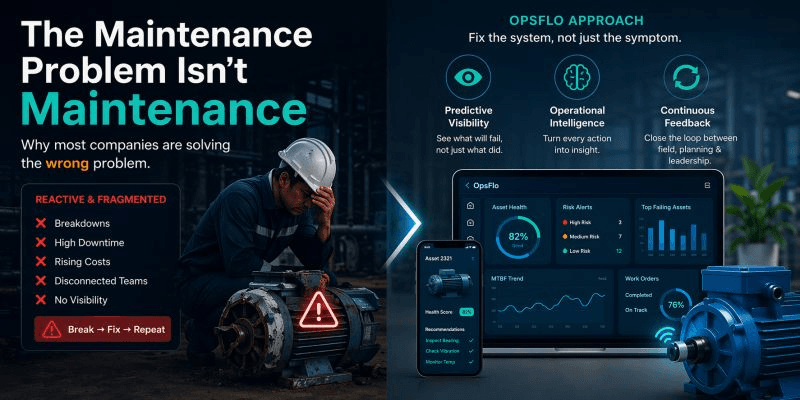
Most maintenance software is built around a simple loop:
Break → Fix → Record → Repeat
This loop assumes the failure has already happened. It optimizes the response, not the prevention. And it explains why companies can invest heavily in CMMS and still have the same number of breakdowns three years later.
You can be incredibly efficient at fixing things, and still be losing the war on uptime.
The shift from workflow to decision intelligence
What needs to change is the framing.
The problem isn’t “how do we manage maintenance work better?” The problem is “how do we make better decisions earlier?” And those are completely different questions with completely different answers.
Better decision-making requires three things that traditional maintenance software doesn’t provide:
1. Connected data across asset, field, and historical context.
The vibration reading means something different when you know the pump has been running 18% higher than its rated load for three weeks. The temperature drift means something different when you know this same asset failed in similar conditions last year. Context turns raw data into signal.
2. Real-time feedback loops between teams.
The operator sees something in the field. The mechanic notices something at the yard. The dispatcher hears something from the customer. Today, these observations live in separate conversations. They need to live in a system where the connection between them is visible.
3. Continuous learning, not periodic review.
Every job that runs is a data point. Every failure that occurs is a lesson. Most operations review this data quarterly, if at all. Decision intelligence demands that the system itself learn from every event continuously.
What this looks like in practice
At OpsFlo, we don’t treat maintenance as a workflow problem to be optimized. We treat it as a decision problem to be solved.
That means a few specific things:
- Asset history isn’t a separate database. It’s the context that every field decision flows from. A technician picking up a tool knows what that tool has done, what failed last time, and what to watch for now.
- Field observations aren’t lost. A voice note from a wellsite gets parsed, tagged to the right asset, and surfaced to the maintenance planner the same day, not three weeks later when paper paperwork arrives.
- Predictive signals trigger work orders, not the other way around. When the system identifies a pre-failure pattern, the work order is generated automatically with the right parts, the right technician, and the right intervention window.
The result isn’t faster maintenance. It’s fewer maintenance events. Fewer failures. Fewer surprises.
The shift you need to make
If you’re spending your time figuring out how to make your maintenance team faster at responding to breakdowns, you’re solving the wrong problem.
The right problem is: how do you make breakdowns less frequent in the first place? And that question gets answered with visibility, not workflow.
Stop optimizing the loop. Break it.
Ready to see what decision intelligence looks like for your operation? Schedule a 30-minute conversation with our team. We’ll walk through your current maintenance signature and show you where visibility, not effort, is the missing piece.
No comments yet
Be the first to share your thoughts.
Leave a Reply
Your email address will not be published. Required fields are marked *