
Off-the-Shelf Field Service Software Is Failing Oilfield Companies. Here's the Proof.
Off-the-shelf platforms promise oilfield-ready capability. Here’s why they keep failing where it counts, and what purpose-built actually means.
The pitch is familiar. A vendor walks into your conference room. They show a beautiful dashboard. They mention their customers: a few oil & gas names sprinkled among the HVAC, telecom, and facilities companies. They promise oilfield-ready workflows and rapid implementation.
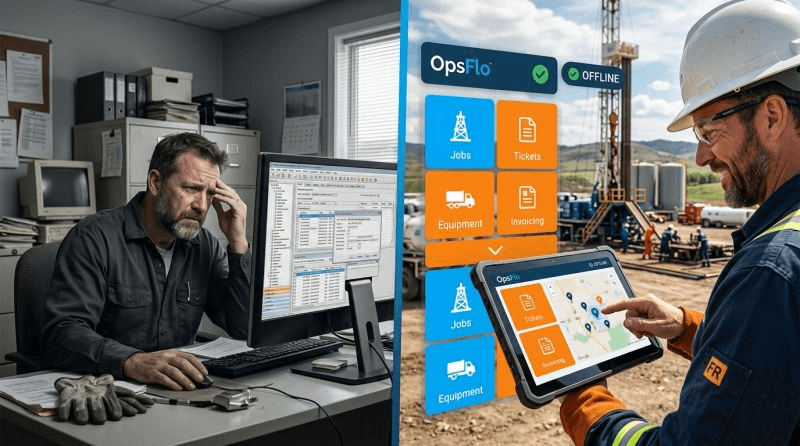
You sign. You implement. And six months later, your field crews are back to paper, your back office is patching gaps with spreadsheets, and your COO is asking what happened.
This pattern repeats often enough in oilfield services that it’s worth understanding why, and what the alternative actually looks like.
Where generic field service software fails
Off-the-shelf platforms promise oilfield-ready capability. Here’s why they keep failing where it counts, and what purpose-built actually means.
The pitch is familiar. A vendor walks into your conference room. They show a beautiful dashboard. They mention their customers: a few oil & gas names sprinkled among the HVAC, telecom, and facilities companies. They promise oilfield-ready workflows and rapid implementation.
You sign. You implement. And six months later, your field crews are back to paper, your back office is patching gaps with spreadsheets, and your COO is asking what happened.
This pattern repeats often enough in oilfield services that it’s worth understanding why, and what the alternative actually looks like.
Where generic field service software fails
The failure modes are consistent across deployments:
Failure mode 1: Workflows that don’t match reality.
Generic field service software is built around a model of work that doesn’t fit oilfield. The model assumes:
- 1–2 hour service visits
- Single technician per job
- Clear start and end times
- Customer at a fixed location with reliable connectivity
- Standard service catalogs
Oilfield reality is the opposite of all five. Jobs run for days, not hours. Crews rotate during the job. Start and end times are fuzzy because mobilization, standby, and demob are all distinct billable events. Customers are at remote wellsites. Service catalogs vary by sub-vertical, by customer, by basin.
When generic workflows hit oilfield reality, they break. The result is crews working around the system instead of with it.
Failure mode 2: Offline performance that doesn’t survive contact with the field.
Every vendor will tell you their platform has offline mode. The marketing slide always includes the airplane mode test in the conference room.
In practice, “offline mode” in most generic FSM tools means:
- A few hours of offline capability before sync issues start
- Limited functionality offline: some workflows work, others don’t
- Conflict resolution that’s brittle or non-existent when sync finally happens
- Background sync attempts that drain device batteries
Oilfield operations require platforms that operate fully offline for days or weeks at a time, with intelligent conflict resolution and bandwidth-aware sync. Generic tools rarely deliver this.
Failure mode 3: Billing logic that can’t handle oilfield complexity.
Oilfield billing isn’t a single rate times a number of hours. It includes:
- Mobilization charges
- Standby time at reduced rates
- Day rates with thresholds for partial days
Why Generic Field Service Software Keeps Failing in the Oilfield
Off-the-shelf platforms promise oilfield-ready capability. Here is why they keep failing, and what purpose-built actually means.
The pitch is familiar. A vendor walks into your conference room with a beautiful dashboard. They mention a few oil and gas names among their HVAC and telecom customers. They promise oilfield-ready workflows and rapid implementation.
You sign. You implement. Six months later, your field crews are back to paper, your back office is patching gaps with spreadsheets, and your COO is asking what happened.
Where Generic Field Service Software Fails
Failure 1: Workflows That Don’t Match Reality
Generic FSM assumes:
- 1–2 hour service visits
- Single technicians
- Clear start/end times
- Reliable connectivity
- Standard catalogs
Oilfield reality is the opposite:
- Jobs run for days, not hours
- Crews rotate in and out
- Mobilization, standby, and demob are distinct billable events
- Customers are at remote wellsites with no cell signal
When the workflow model is wrong, everything downstream breaks: time capture, approvals, billing, and reporting.
Failure 2: Offline That Doesn’t Survive the Field
“Offline mode” in most generic FSM tools means:
- A few hours of offline before sync fails
- Limited functionality when disconnected
- Brittle conflict resolution
- Heavy battery drain on devices
Oilfield requires:
- Full offline operation for days or weeks
- All core workflows available with no signal
- Intelligent conflict resolution when devices reconnect
- Zero data loss, even across crew changes and long jobs
If the platform assumes connectivity, it will fail where you work most.
Failure 3: Billing Logic That Can’t Handle Oilfield
Oilfield billing is not a simple time-and-materials problem. It includes:
- Mobilization and demobilization charges
- Standby time at reduced rates
- Day rates with partial-day thresholds
- Equipment rental with partial returns
- Consumables with customer-specific pricing
- Multi-line service codes and complex rate tables
Generic tools handle the simple case and fail at the complex one. The result is:
- Manual adjustments in spreadsheets
- Revenue leakage from missed billables
- Disputes with customers over unclear tickets
Failure 4: Integration Debt That Grows
Generic integrations connect to standard ERPs and generic accounting flows. Oilfield needs more:
- Operator-specific ticket formats and approval flows
- Basin-specific compliance requirements
- Vendor portals like OpenInvoice and others
- Data feeds to customer systems and internal data lakes
Every gap becomes a custom integration. Over time:
- Your “platform” turns into a custom application
- No one wants to own or change it
- Upgrades become risky and expensive
Failure 5: A Roadmap That Goes Elsewhere
When 80% of a vendor’s customers are non-oilfield, the product roadmap reflects that reality:
- Features prioritize HVAC, telecom, and generic field service
- Oilfield-specific issues get deprioritized or deferred
- Critical gaps stay open for years
Two years in, the platform has drifted even further away from your operations.
What Purpose-Built Actually Means
“Purpose-built” is more than a marketing phrase. It shows up in how the product is designed, implemented, and evolved.
Workflows Native to Upstream Operations
In a purpose-built oilfield platform, upstream workflows are the core, not add-ons:
- Frac stage tracking and job progression
- Wireline run management and depth-based operations
- Rental day calculations with partial returns and swaps
- Multi-crew completions and simultaneous operations
- Job packages, JSA, and HSE workflows aligned to field reality
You configure details, but you don’t have to invent the model from scratch.
Offline-First Architecture
Not offline-tolerant. Offline-first.
The platform:
- Assumes connectivity will fail
- Stores and processes data locally on the device
- Syncs intelligently when a connection appears
- Handles conflicts across crews and devices without losing data
Field users can:
- Start, run, and close jobs fully offline
- Capture signatures, photos, and forms at the wellsite
- Hand off devices across crews without breaking the record of work
Billing That Matches Contract Reality
Billing logic is built around oilfield contracts:
- Standby, mobilization, and demob as first-class concepts
- Day rates, hourly rates, and hybrid structures
- Partial days with thresholds and minimums
- Equipment rental with partial returns and on/off rent rules
- Consumables with customer-specific pricing and discounts
- Multi-line service codes tied directly to field capture
The result:
- Tickets that match contracts
- Faster approvals
- Less revenue leakage
- Less manual rework in the back office
Compliance Built In
Compliance is not a custom configuration project; it’s standard capability:
- PHMSA-related workflows where applicable
- State-specific HSE rules and required forms
- Customer-specific documentation and checklists
- Audit trails for who did what, where, and when
You adapt templates to your operations instead of building from zero.
A Product Roadmap Focused on You
With a vendor whose customer base is overwhelmingly oilfield:
- Your use cases are the default, not the exception
- Feature requests come from operators and service companies like yours
- Roadmap decisions are anchored in upstream and midstream operations
Over time, the platform gets more aligned with your work, not less.
The Honest Comparison
The real question is not:
"Which platform has the most features?"
It is: "Which platform was designed for the work we actually do?"
The difference shows up in adoption rates, implementation timelines, operational outcomes, and total cost. Generic tools cost less on paper. Purpose-built tools cost less in practice.
Want to see what purpose-built looks like? Schedule a demo with our team. We will walk through OpsFlo workflows for your specific service lines and geography.
No comments yet
Be the first to share your thoughts.
Leave a Reply
Your email address will not be published. Required fields are marked *