
The Invisible Gaps in Your Oilfield Safety Program (And How to Close Them)
Why most oilfield safety programs have invisible gaps, and how digital HSE workflows close them.
Walk into any oilfield services company and ask about safety culture. You’ll hear the right answers. Safety is the first slide of the all-hands. Safety is the first agenda item of the morning toolbox talk. Safety is what gets you home to your family.
This is real. It’s not lip service. The leaders mean it.
And yet: incidents still happen. Near misses go unreported. Compliance findings show up in audits. The disconnect between safety commitment and safety performance is one of the most uncomfortable patterns in the industry.
The cause isn’t culture. It’s infrastructure.
Where the gaps form
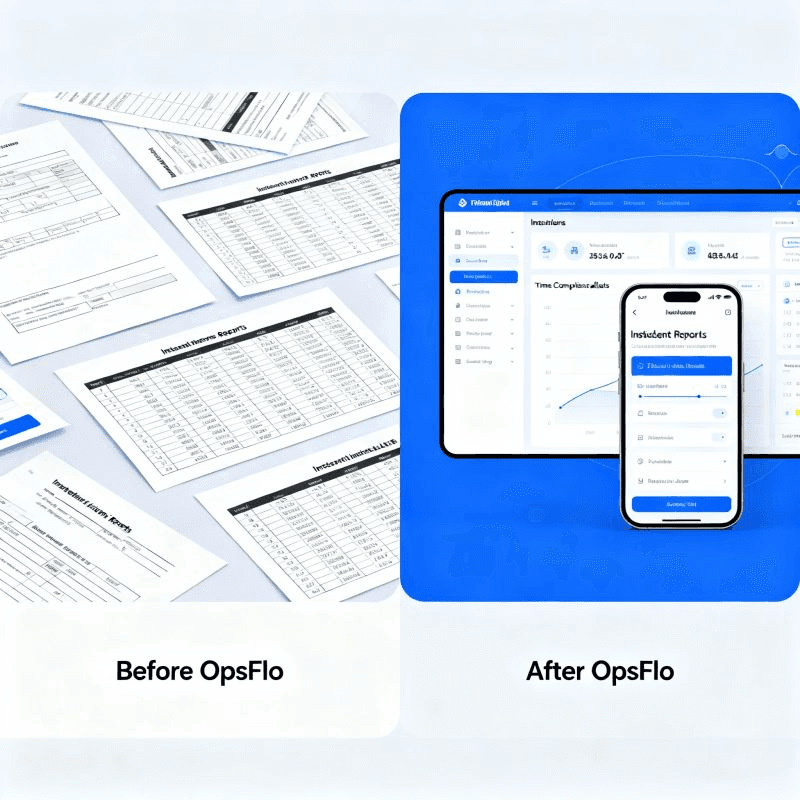
Traditional safety methods (paper inspection forms, monthly committee meetings, manual incident reporting) were designed in an era before mobile devices. They’ve evolved, but the core workflow hasn’t fundamentally changed in 30 years.
The gaps form in five specific places:
Gap 1: The delay between observation and report.
A technician notices a near-miss in the field. By the time they’ve made it back to the yard, written it up, dropped it in the safety inbox, and had it processed, it’s been 3–5 days. The pattern that could have been caught early is buried in paperwork.
Gap 2: The friction in incident reporting.
If reporting a near-miss requires a 12-page form filled out by hand, most near-misses don’t get reported. The friction kills the workflow. The result: leading indicators (near-misses) are systematically under-reported while lagging indicators (incidents) are over-represented.
Gap 3: Compliance documentation that exists in silos.
When PHMSA shows up for an audit, the integrity team starts a multi-day fire drill of pulling inspection records from different folders, different systems, and different people’s desks. The information exists. It’s just not in any one place.
Gap 4: No closed loop between inspection and action.
The most damaging gap. An inspector identifies a deficiency. The deficiency is recorded. And then nothing happens: the work order never gets created, or it gets created but never assigned, or it gets assigned but never completed. The original finding sits in a folder while the underlying risk continues to exist in the field.
Gap 5: Real-time visibility for supervisors.
When something happens in the field, the supervisor often doesn’t know for hours or days. The information lives with the crew. By the time it reaches the supervisor’s desk, the moment to intervene has passed.
What digital HSE actually changes
The fix isn’t more safety meetings. It’s removing the friction and gaps from the safety workflow.
What modern digital HSE looks like:
Centralized safety and compliance data.
Inspections, near-misses, incidents, JSA records, training certifications: all in one platform, all searchable, all linked to the assets and crews they reference. When an audit happens, the documentation exists in one place.
Mobile incident reporting with geo-tagging.
A near-miss can be reported in 90 seconds from a tablet at the wellsite. Voice notes for the narrative, photos for evidence, GPS for location. The report is in the system before the crew leaves the site.
Automated compliance checklists.
The right inspection appears based on the job type, the location, the regulatory jurisdiction, and the operator’s specific requirements. Crews can’t accidentally skip a required check, because the checklist won’t let them.
Closed-loop workflow from inspection to resolution.
Every “fail” or “warning” on an inspection automatically generates a tracked work order assigned to the right technician with appropriate severity classification. The inspection-to-action gap closes.
Real-time supervisor visibility.
Supervisors see incidents, near-misses, and compliance flags as they happen. The window for intervention reopens.
Conversational data access.
Instead of building reports, supervisors and HSE managers can ask questions of the system directly. “Show me all the near-misses related to manual lifting in the past 90 days.” “Pull the inspection records for that pipeline segment.” The answer comes in seconds, not days.
Results that matter
Operators using modern digital HSE workflows consistently report:
- 75% faster incident reporting cycles: near-misses get logged within hours, not days
- 80% reduction in manual compliance effort: documentation is auto-generated from the audit trail
- Significantly fewer incidents over time: because leading indicators are now visible and actionable
- Zero compliance penalties stemming from documentation gaps
The pattern is consistent across deployments. When the infrastructure stops fighting the workflow, the safety culture that was always there can finally function.
The honest assessment
Most oilfield services companies have outstanding safety culture and inadequate safety infrastructure. The leaders aren’t the problem. The crews aren’t the problem. The paper-based, fragmented, manually-reconciled systems that the safety program runs on are the problem.
Closing the gap doesn’t require a culture change. It requires removing the friction that’s preventing the culture from translating into outcomes.
Want to see what digital HSE looks like for your operation? Book a call to walk through how OpsFlo handles incident reporting, compliance documentation, and inspection-to-resolution workflows.
No comments yet
Be the first to share your thoughts.
Leave a Reply
Your email address will not be published. Required fields are marked *