

Paper Field Tickets Are Costing You Millions. Here's the Math.
Paper field tickets still run most of the industry. Here’s what they’re quietly costing you, and why the math on going digital is overwhelming.
Walk into the yard of any oilfield services company at the end of a hitch, and you’ll see something familiar: a stack of paper field tickets, dog-eared, often water-stained, occasionally illegible, waiting to be processed.
These tickets are the operational backbone of the company. They authorize billing. They document work. They serve as the record of what happened in the field.
They also quietly destroy margin. Most companies have never calculated how much.
This post breaks down the hidden cost of paper field tickets, and why the math on going digital is more compelling than most operators realize.
Why paper tickets persist
Despite a decade of digital transformation rhetoric in oilfield services, paper field tickets are still the dominant capture method. Industry estimates suggest 60-75% of oilfield services companies still use paper in some form.
The reasons aren’t irrational:
- Paper works when connectivity doesn’t
- Crews are familiar with it
- Customers will accept it
- The cost of paper is visible (low) while the cost of paper-driven inefficiency is hidden
- Past attempts at digital tickets have failed, often spectacularly
So paper persists. And the hidden costs accumulate.
Paper field tickets are quietly costing you millions
Walk into the yard of any oilfield services company at the end of a hitch and you’ll see something familiar: a stack of paper field tickets, dog‑eared, water‑stained, occasionally illegible, waiting to be processed.
Those tickets are the operational backbone of the company. They authorize billing. They document work. They’re the record of what happened in the field.
They also quietly destroy margin.
Most operators have never actually done the math.
This breakdown shows the hidden cost of paper field tickets—and why the numbers on going digital are far more compelling than most teams realize.
---
Why paper tickets are still here
Despite a decade of “digital transformation,” paper field tickets still dominate. Industry estimates: 60–75% of oilfield services companies still use paper in some form.
That’s not irrational. Paper persists because:
Every handwritten field ticket represents revenue at risk.
Here is the math on what paper is actually costing your operation.
Your field crews write thousands of tickets each month. Mobilization, standby, hourly work, equipment usage, consumables, all captured on paper. Each ticket represents revenue earned in the field that must survive a journey through data entry, approval, and invoicing to become collected revenue.
The problem is that this journey has a shocking failure rate. And the cost of those failures is measured in millions.
The Paper Ticket Revenue Leak
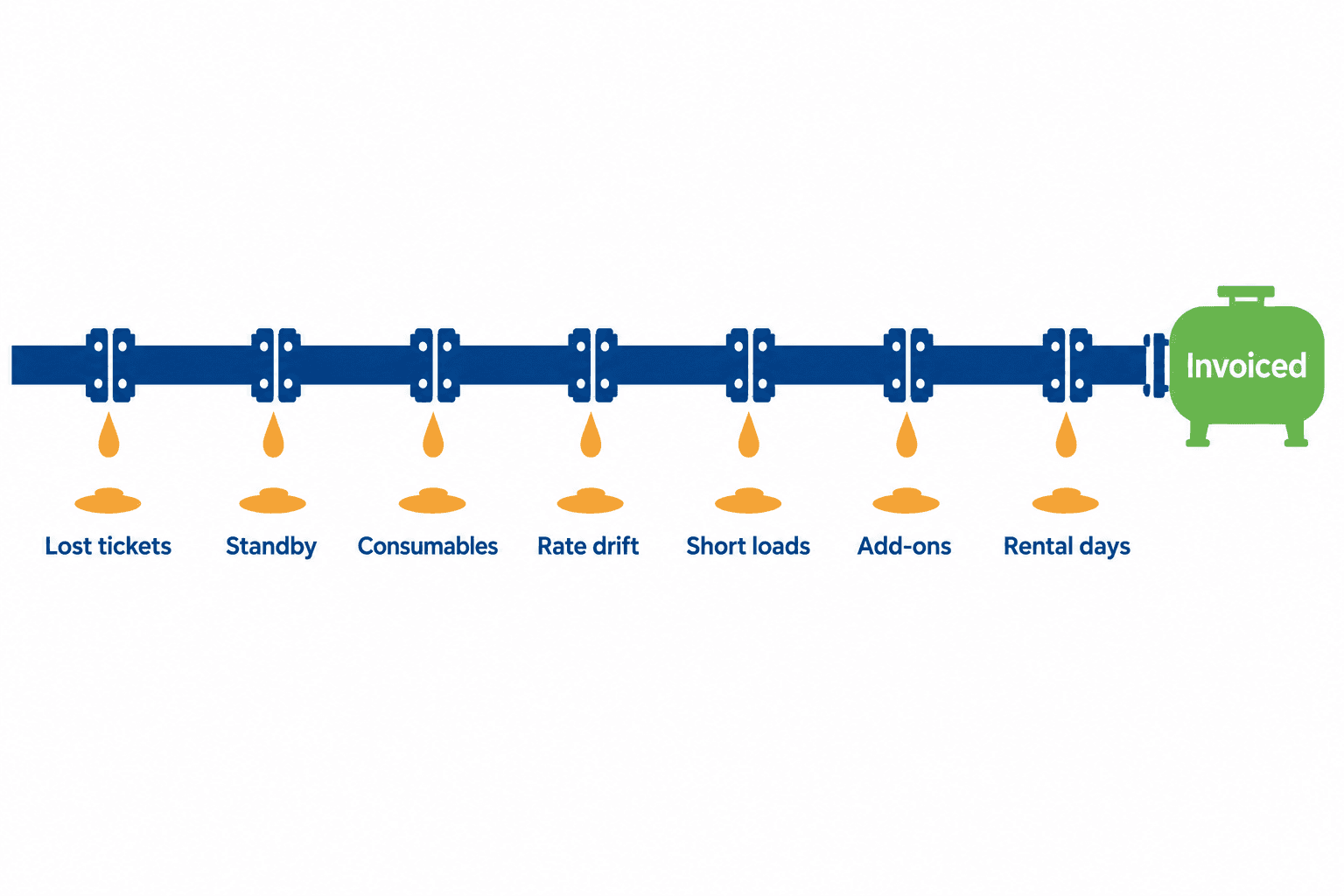
Data entry errors. When tickets are transcribed from paper, approximately 3–7% contain errors that reduce billable amounts. Misread rates, wrong equipment codes, missed line items, transposed quantities.
Lost and damaged tickets. In wet, muddy, windy field conditions, 1–3% of paper tickets never make it to the office at all. Each one represents revenue that was earned but will never be invoiced.
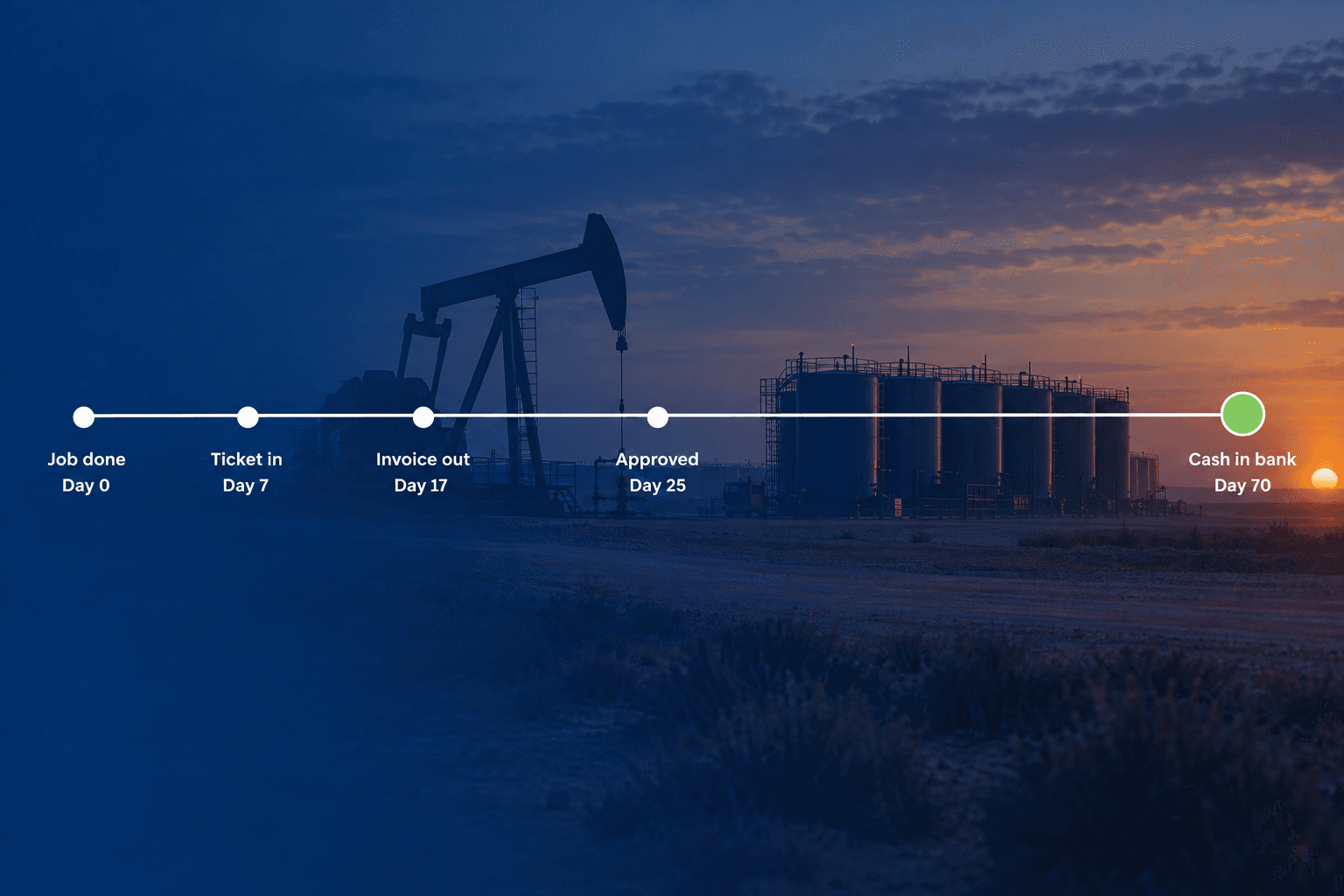
Delayed submission. Paper tickets that take days or weeks to reach the office push invoicing cycles out. Late invoices face higher dispute rates and slower payment, costing 2–4% in effective revenue.
Underbilling from memory gaps. When crews fill out tickets at end of shift (or end of hitch), they undercount. Short standby periods, extra consumables, partial-hour minimums: all forgotten, all unbilled.
Dispute losses. When customers dispute charges, paper documentation is hard to defend. No GPS confirmation, no timestamps, no photos. Dispute write-offs typically run 1–3% of revenue.
The Math
For a mid-size oilfield service company billing $30M annually:
- Data entry errors: $900K–$2.1M in underbilling
- Lost tickets: $300K–$900K in unbilled work
- Delayed submission: $600K–$1.2M in write-offs and payment delays
- Underbilling from memory: $450K–$1.5M in missed charges
- Dispute losses: $300K–$900K in write-offs
Total annual leakage: $2.5M–$6.6M, or 8–22% of revenue.
What Digital Field Tickets Solve
Real-time capture. Crews capture work as it happens: start/stop times, equipment scans, consumable counts, photos. No memory gaps, no end-of-shift reconstruction.
Automated billing codes. The system applies correct billing codes, rate tables, and minimums automatically. No manual lookup, no transcription errors.
GPS and timestamp validation. Every ticket entry includes location and time proof. Disputes become rare when documentation is irrefutable.
Instant submission. Tickets sync when connectivity is available. No physical transport, no lost paperwork, no multi-week delays.
Approval workflows. Customer sign-off happens digitally in the field. Approved tickets flow directly to invoicing with no data re-entry.
The Transition Challenge
The reason companies stay on paper is not that digital is unavailable. It is that previous digital solutions failed because they required constant connectivity, had poor offline support, were too complex for field crews, did not match oilfield billing complexity, or created more work than paper.
Purpose-built oilfield platforms solve these problems by designing for offline-first, one-thumb operation, and native oilfield billing logic.
Ready to see what your paper tickets are actually costing? Contact our team for a revenue leakage assessment based on your actual ticket volumes and billing rates.
No comments yet
Be the first to share your thoughts.
Leave a Reply
Your email address will not be published. Required fields are marked *