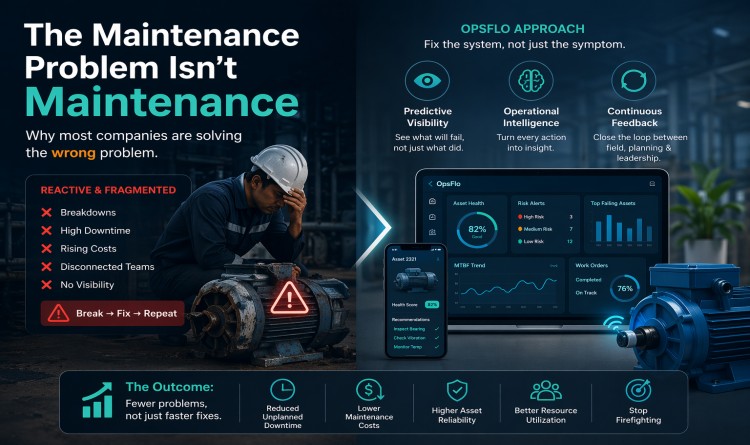
When companies talk about “maintenance challenges,” they usually mean things like:
Too many breakdowns
High downtime
Rising maintenance costs
Poor technician productivity
So they respond the obvious way:
They buy maintenance software. And yet… nothing fundamentally improves. Downtime persists. Costs creep up. Teams remain reactive. That’s because maintenance is not the real problem.
The real issue: fragmented operations
Maintenance failures are rarely caused by a lack of tools.
They’re caused by disconnected decisions across the lifecycle of an asset. Think about what actually leads to a breakdown:
Incomplete asset history
Poor visibility into field conditions
Delayed or inaccurate reporting
Reactive work order creation
No feedback loop between field and planning
Most systems treat maintenance as an isolated function. But in reality, maintenance is just a downstream symptom of operational blind spots.
Why traditional systems fail
Most maintenance platforms focus on tracking work instead of preventing work. They help you:
Log tickets
Assign technicians
Track completion
But they don’t answer:
Why did this issue happen in the first place?
Could we have predicted it earlier?
What pattern are we missing across sites?
This leads to a cycle of: Break → Fix → Repeat Efficient, perhaps. But still reactive.
The OpsFlo approach: Fix the system, not just the symptom
OpsFlo approaches maintenance differently.
Instead of treating it as a workflow problem, it treats it as a decision problem.
1. From reactive to predictive visibility
OpsFlo connects asset data, field inputs, and historical patterns into a single layer of visibility. This means you don’t just see what failed. You understand why it was likely to fail
2. From work orders to operational intelligence
Rather than just managing tasks, OpsFlo turns every field action into usable insight:
Which assets fail most frequently
Which conditions trigger issues
Which interventions actually work
Over time, maintenance becomes smarter, not just faster.
3. From siloed teams to continuous feedback loops
Maintenance doesn’t live in isolation. OpsFlo ensures that: This closes the loop between execution and decision-making.
Field teams feed real-time insights
Planning teams adjust strategies
Leadership sees system-level trends
This closes the loop between execution and decision-making.
The outcome: fewer problems, not just faster fixes
Companies using this approach don’t just improve maintenance KPIs. They fundamentally change how operations run:
Reduced unplanned downtime
Lower cost of maintenance
Higher asset reliability
Better resource utilization
But more importantly: They stop firefighting.
A shift in mindset
If you’re still thinking about maintenance as something to manage, you’ll keep chasing efficiency gains. If you start thinking about it as something to eliminate at the source, you unlock a completely different level of performance. That’s the shift OpsFlo is built for.